I’m in Malaysia now, just arrived last night with Huzaifah and got a really warm welcome from Ayah, Mak and Lia, our helper – who rushed to hug and kiss a surprised Huzaifah. He was okay in the flight – not quite cranky like he was on his first journey by flight last March. I guess, it might have something to do with the fact that he enjoyed the spacious and automatic seat in the business class. No, I don’t normally travel on business class unless on official trip. But this time around, I bought the business class ticket because the economy class was full, or so I was told by the travel agent I dealt with. Huzaifah and I took a walk down the aisle all the way to the back of the flight, and found out that in fact there were many vacant seats in economy class… but I am not complaining because traveling alone with a child who has just learned to walk but not yet understand how to stand still for a while could be quite a harrowing experience. I know I definitely received a lot of glances from others while trying to fill in the embarkation forms for both Huzaifah and I right before we went through the immigration in Narita airport. Alhamdulillah, Daud and Sarina went back on the same day with me (but they boarded an earlier flight), so they could give me a lift to the airport, otherwise, managing both the luggage and Huzaifah could prove to be yet another nightmare… Not to mention that the side handle of the big bag was broken while hubby took the bag downstairs…
There’s a long list of things to do – getting replacement for MyKad, driving licence, getting Huzaifah’s one-year-old injection, making new passport, getting new visa for the new passport, paying debts and the usual stuff of meeting and visiting family and friends. Actually neither hubby nor I planned to return this summer, but hubby had to attend to some stuff pertaining to his official appointment as a government servant, so Mak and Ayah persuaded me to take Ujai back home too, to celebrate his first birthday here in Malaysia, insya Allah. Not that we are planning a big celebration, but at least they get to be with him on his first birthday. Lia, our helper too, has miss him a lot. Huzaifah has just been back for less than a day, but already he’s been pampered like a prince. Since the house is not baby-proofed, Huzaifah is more likely to be seen on either Mak’s or Lia’s arm, rather than being allowed to wander and roam all over the house. Mak made beef soup especially for him today, even fed him some Ferraro Rocher chocolate when she saw that he was not that keen to finish the bottled baby meal I brought with me. The slightest ‘eek’ or ‘uuh’ uttered in raised voice by Huzaifah was quickly attended to, even when it was, well, nothing.
Huzaifah is definitely going to be subjected to a reorientation of living with just his dad and I when we go back. Oh, his dad is still in Tokyo right now. Will only be back in Malaysia on 5th September and we will go back together on 20th September, insya Allah. I know – just four days before Ramadhan… Zannen… But I don’t have much choice since the registration for new students in Waseda had been scheduled on 21st September.
I’ll try to update if I can manage to while I am in Malaysia, since the internet seems to be working better this time around than when I came back last year. Till then, take care and have a nice day.
Saturday, August 26, 2006

Sunday, August 20, 2006
Not some blog-wash after all...
* A belated entry which had been sitting in my draft bin for quite some time...
I chuckled when I first heard the news from hubby. I just came back from the hospital, while hubby stayed home that day, not visiting Huzaifah because he himself was not feeling well.
“Ofis lama Haida kena pantau blog-blog pulak…”
Eh, eh, pulak dah…
Hubby was referring to a nwspaper article stating that the Malaysian Cabinet had directed KTAK (as in K.T.A.K, not ktak, or even katak - it used to be KTKM, which were often confused with KTMB, but when the Water related functions were introduced, became KTAK. There had been some efforts to change the abbreviation to KKTA or KKAT, but the request had been turned down by the Cabinet...) to monitor blogs. The Communications department of the Ministry functions according to the provisions of Communications and Multimedia Acts 1998. And Section 3 (3) of CMA 1998 expressly stated that "Nothing in this Act shall be construed as permitting the censorship of the Internet.” . So, why should blogs be monitored when there should be no censorship of the Internet... But I guess, this will be one of the tasks that would go under “lain-lain tugasan seperti yang diarahkan dari semasa ke semasa”…
The government is worried about the spread of rumours and lies by way of blog, or so I was told. If found guilty, identified blog owners would be charged, perhaps under Sedition Act, Printing Presses and Publications Act or even Penal Code. But not CMA – so why ask the Ministry to undertake an effort that the Ministry could not act upon. Hmm, maybe the stakeholders want the Ministry to cooperate and liaise with other government agencies. The police, perhaps, or the Internal Ministry, or even the Bahagian Keselamatan of the Prime Minister’s Department. I chuckled at the thought of liaising with the police force though, remembering how long it took to convince all telecommunications service providers to cooperate with the police in order to increase the efficiency of the emergency call system. Chances are, it would probably be better for the Special Branch officers to continue their own monitoring of identified possible hazardous blogs, rather than relying on the Ministry.
It is funny to think that the call to monitor blogs came not long after a national newspaper loudly pronounced blogs as hokum bunkum (with the cover screaming BLOG-WASH). On one hand the mainstream media are saying that blogs are just some craps not to be minded, yet on the other hand, the government think highly enough of blogs to be capable of influencing the people’s thoughts and opinions. Ah-hah.
But when the task of monitoring blog was awarded to the Ministry, I wonder who will undertake the actual task anyway when the Ministry has almost always been understaffed and overworked for the past couple of years. Probably someone from the Content division. Or maybe someone from the Regulatory division. I also wonder, why not delegate the task to Communications and Multimedia Commission - they certainly have more people there than the Ministry... But then again, they too are supposed to function in accord with CMA 1998, which brought us to my above-mentioned point...
I wonder what will be the Key Performance Index (KPI) for this task – perhaps, how many blogs should be monitored a year, or how many blogs had been taken action against (when necessary), or that blogs would be classified so that some would not be touched at all (the kind that rants on and on about on and on, but nothing of great importance so as to pose a threat to national security) but only a handful which fulfill certain criteria would be subject to close scrutiny.
At the end of the day, I pretty much envy the person who would be in charge of monitoring blogs. Imagine, spending all day long blog-hopping, possibly becoming addicted to some, and one can honestly say that he or she is just carrying out the assigned official duty…
I chuckled when I first heard the news from hubby. I just came back from the hospital, while hubby stayed home that day, not visiting Huzaifah because he himself was not feeling well.
“Ofis lama Haida kena pantau blog-blog pulak…”
Eh, eh, pulak dah…
Hubby was referring to a nwspaper article stating that the Malaysian Cabinet had directed KTAK (as in K.T.A.K, not ktak, or even katak - it used to be KTKM, which were often confused with KTMB, but when the Water related functions were introduced, became KTAK. There had been some efforts to change the abbreviation to KKTA or KKAT, but the request had been turned down by the Cabinet...) to monitor blogs. The Communications department of the Ministry functions according to the provisions of Communications and Multimedia Acts 1998. And Section 3 (3) of CMA 1998 expressly stated that "Nothing in this Act shall be construed as permitting the censorship of the Internet.” . So, why should blogs be monitored when there should be no censorship of the Internet... But I guess, this will be one of the tasks that would go under “lain-lain tugasan seperti yang diarahkan dari semasa ke semasa”…
The government is worried about the spread of rumours and lies by way of blog, or so I was told. If found guilty, identified blog owners would be charged, perhaps under Sedition Act, Printing Presses and Publications Act or even Penal Code. But not CMA – so why ask the Ministry to undertake an effort that the Ministry could not act upon. Hmm, maybe the stakeholders want the Ministry to cooperate and liaise with other government agencies. The police, perhaps, or the Internal Ministry, or even the Bahagian Keselamatan of the Prime Minister’s Department. I chuckled at the thought of liaising with the police force though, remembering how long it took to convince all telecommunications service providers to cooperate with the police in order to increase the efficiency of the emergency call system. Chances are, it would probably be better for the Special Branch officers to continue their own monitoring of identified possible hazardous blogs, rather than relying on the Ministry.
It is funny to think that the call to monitor blogs came not long after a national newspaper loudly pronounced blogs as hokum bunkum (with the cover screaming BLOG-WASH). On one hand the mainstream media are saying that blogs are just some craps not to be minded, yet on the other hand, the government think highly enough of blogs to be capable of influencing the people’s thoughts and opinions. Ah-hah.
But when the task of monitoring blog was awarded to the Ministry, I wonder who will undertake the actual task anyway when the Ministry has almost always been understaffed and overworked for the past couple of years. Probably someone from the Content division. Or maybe someone from the Regulatory division. I also wonder, why not delegate the task to Communications and Multimedia Commission - they certainly have more people there than the Ministry... But then again, they too are supposed to function in accord with CMA 1998, which brought us to my above-mentioned point...
I wonder what will be the Key Performance Index (KPI) for this task – perhaps, how many blogs should be monitored a year, or how many blogs had been taken action against (when necessary), or that blogs would be classified so that some would not be touched at all (the kind that rants on and on about on and on, but nothing of great importance so as to pose a threat to national security) but only a handful which fulfill certain criteria would be subject to close scrutiny.
At the end of the day, I pretty much envy the person who would be in charge of monitoring blogs. Imagine, spending all day long blog-hopping, possibly becoming addicted to some, and one can honestly say that he or she is just carrying out the assigned official duty…
Thursday, August 17, 2006
Another new Muslimah
We received the phone call when we were in the middle of attending to our child when he was terribly sick.
It was a Yemeni guy, asking us about necessary documents for someone to convert to Islam, as well as trying to make an appointment for a new Muslim conversion. I told him that he could bring his friend for conversion anytime but right then the timing was a bit off because we had a sick child to attend to. Hubby asked him to come to the mosque the next day.
At that time it did not occurred to us that Huzaifah would be hospitalized. Thus, when he was, hubby asked me to call up more senior members of ICOJ to attend to the Yemeni guy’s request since we might be held up at the hospital. We called, but it seemed that nobody was quite free that night to cater to the Yemeni’s guy request. Hubby decided to leave the hospital earlier than me, to prepare all the necessary documents and gifts (Islamic books for beginners) in case the guy show up with his friend - “Orang nak masuk Islam tak boleh lengah-lengahkan, nanti kalau jadi apa-apa, kita nak jawab apa…”
I left the hospital at 8.00 pm, after Huzaifah had gone to sleep. (Alhamdulillah, he always napped right before I had to leave the hospital, making it easier for me to leave quietly without seeing him crying, protesting my going away) I noticed the two extra pair of shoes on the shoe rack, but I found hubby alone in the office. We went upstairs together, and only then hubby noticed that there were two people waiting in the mosque after all – the Yemeni guy and his Nihonjin girlfriend.
Turned out that they hadn’t been waiting long, just that they didn’t know where to look for the Imam. They first introduced themselves in English, but soon after that hubby began conversing in Arabic with Hadi, the Yemeni guy while I chatted in my limited Nihongo with Sonoko-san. I apologized for our late welcome since I myself had just returned from the hospital. (It had been a long day for me – what with having to register Huzaifah for child welfare in Taito-ku ward office in Ueno first, and they requested some documents I’ve never heard of before, making it a lot more complicated than it was back in Gyotoku… In fact, that day, I reached the hospital later than Huzaifah’s other visitors – Kamarol and Mizan and his family, who were kind enough to visit all the way from Chiba…)
Things went far smoother this time compared to our first conversion experience. Hubby had prepared his script beforehand, spoke in Arabic and Hadi acted as translator for Sonoko-san. I was impressed with Hadi’s Nihongo, because he was so fluent and there was little trace of Arabic slang if at all in his Nihongo. I later found out that he’s a teacher in Yemen who works part time as tourist guide for Japanese and that was how he first met Sonoko-san. He was in Japan on Sonoko’s family invitation, to visit Sonoko-san’s father who has been hospitalized for some old age-related problems.
Actually, I was not only impressed, I was also envious. To date, while I may not be fluent, most Nihonjin I’ve talked to, often remarked that my Nihongo is rather good for someone who has been here for less than a year. However, since Nihonjin are known to be extra polite sometimes, I’m unsure whether they were honestly stating a fact or just being polite. Since our move to this mosque, my priority in learning Nihongo has shifted from trying to understand Japanese dorama, to at least be able to explain basic stuff in Islam to others who are interested to learn. The truth is, I can understand TV programs in Nihongo up to some extend now, but my spoken Nihongo is still too poor for me to be able to explain even Rukun Iman or Rukun Islam… I could answer simple questions like what time is Jumu’ah prayer held in the mosque, or do we have Quran lesson in the mosque, but whenever we get some phone calls asking fiqh related stuff, I always had to direct the callers to call others. It’s nothing to be ashamed of, and that was exactly we had been advised to do by ICOJ committee members, but I still feel that I should be able to do better than that…
Anyway, back to the conversion…
Sonoko-san’s interest in Islam was first generated as she toured in a few Muslim countries – Yemen, Syria, Iran, Malaysia, Indonesia, to name a few. She too has taken an interest in learning Arabic, and in turn was further encouraged to learn more about Islam by her Indonesian Arabic language instructor. Understandably, her decision to convert was not well received by her family, but the presence of her Yemeni boyfriend in person had helped her to get that extra boost of confidence to take the leap of faith.
Just before converting, hubby asked her some questions relating to her interest in Islam, and her understanding of Islam so far, as well as whether she has come to Islam out of her own free will. It seemed that she had found a good coach in Hadi, who has helped in explaining and answering her questions before this. She too had ‘rehearsed’ uttering the syahadah, so when the time came for her to declare herself as a Muslim, it went rather well, as her Arabic is rather jouzu for a Nihonjin. She chose an old Arabic name, Lamees, as her Muslim name (as opposed to Fatimah, Aisyah and Mariam, popular names for Muslim Nihonjin), even saying “Ismi Lamees” (”My name is Lamees” in Arabic) when hubby asked her what is her Muslim name. No, it is not compulsory to have a new Muslim name when one becomes a Muslim, (Rasulullah’s companions did not change their name after their conversion just for the sake of changing their name – Umar was Umar before he became a Muslim and remained Umar after he converted) it is just a custom to do so, but I thought Lamees is a beautiful name which suits her nicely.
Hubby then proceeded to explain to her the basic tenets – Rukun Islam and Rukun Iman – in Arabic which was translated to Nihongo by Hadi. Then, after she was done with filling in her details, with Hadi and I acting as witnesses for her conversion, hubby handed a copy of the new Muslim certificate over to her. She held it with a wondrous look for a moment just before I requested for permission to take a photo of her showing off the certificate. She looked happy posing for the camera. Hadi even clapped his hand as he muttered omedetou gozaimas (congratulations) to her.
I then promised to call up another Muslim Nihonjin who might be able to answer her questions better and have better knowledge than me regarding Islamic classes conducted in Nihongo held in other Islamic center and mosques. She would like that, because she really want to learn more about Islam. It’s a new start, it’s a new life and she looks forward to learning being a good Muslim.
She knows that it’s not going to be easy. It is never easy for many. Most Muslim Nihonjin take some time adjusting to their new faith – to stop their drinking habit, change their eating habits, start praying… She was aware that it’s going to be a tough challenge, and it may take her five, six, or even ten years before she could be a fully practicing Muslim I encouraged her to take her time. What is important first and foremost is her belief in Allah AlMighty. Everything else will fall in its places accordingly, insya Allah.
I was surprised to learn that she lived in Shibuya, not too far from a famous mosque. I wondered loudly why they did not go there instead of coming all the way to Asakusa for her conversion. Hadi explained briefly that when he called them up, stating his interest in bringing a friend for a conversion ceremony, the mosque’s response had been rather cool. Yet, when he called us, both hubby and I welcomed him warmly, sounding eager to assist in any way we could. Thus, they chose to come to us.
Shocked and sad – my expression must had conveyed what I felt right then to them because she immediately reassured me that it’s okay, it doesn’t matter where she does it right, because she is already a Muslim now.
She is getting married to Hadi soon, and insya Allah I will share more about their wedding ceremony because they had chose to get married in Asakusa too.
It was a Yemeni guy, asking us about necessary documents for someone to convert to Islam, as well as trying to make an appointment for a new Muslim conversion. I told him that he could bring his friend for conversion anytime but right then the timing was a bit off because we had a sick child to attend to. Hubby asked him to come to the mosque the next day.
At that time it did not occurred to us that Huzaifah would be hospitalized. Thus, when he was, hubby asked me to call up more senior members of ICOJ to attend to the Yemeni guy’s request since we might be held up at the hospital. We called, but it seemed that nobody was quite free that night to cater to the Yemeni’s guy request. Hubby decided to leave the hospital earlier than me, to prepare all the necessary documents and gifts (Islamic books for beginners) in case the guy show up with his friend - “Orang nak masuk Islam tak boleh lengah-lengahkan, nanti kalau jadi apa-apa, kita nak jawab apa…”
I left the hospital at 8.00 pm, after Huzaifah had gone to sleep. (Alhamdulillah, he always napped right before I had to leave the hospital, making it easier for me to leave quietly without seeing him crying, protesting my going away) I noticed the two extra pair of shoes on the shoe rack, but I found hubby alone in the office. We went upstairs together, and only then hubby noticed that there were two people waiting in the mosque after all – the Yemeni guy and his Nihonjin girlfriend.
Turned out that they hadn’t been waiting long, just that they didn’t know where to look for the Imam. They first introduced themselves in English, but soon after that hubby began conversing in Arabic with Hadi, the Yemeni guy while I chatted in my limited Nihongo with Sonoko-san. I apologized for our late welcome since I myself had just returned from the hospital. (It had been a long day for me – what with having to register Huzaifah for child welfare in Taito-ku ward office in Ueno first, and they requested some documents I’ve never heard of before, making it a lot more complicated than it was back in Gyotoku… In fact, that day, I reached the hospital later than Huzaifah’s other visitors – Kamarol and Mizan and his family, who were kind enough to visit all the way from Chiba…)
Things went far smoother this time compared to our first conversion experience. Hubby had prepared his script beforehand, spoke in Arabic and Hadi acted as translator for Sonoko-san. I was impressed with Hadi’s Nihongo, because he was so fluent and there was little trace of Arabic slang if at all in his Nihongo. I later found out that he’s a teacher in Yemen who works part time as tourist guide for Japanese and that was how he first met Sonoko-san. He was in Japan on Sonoko’s family invitation, to visit Sonoko-san’s father who has been hospitalized for some old age-related problems.
Actually, I was not only impressed, I was also envious. To date, while I may not be fluent, most Nihonjin I’ve talked to, often remarked that my Nihongo is rather good for someone who has been here for less than a year. However, since Nihonjin are known to be extra polite sometimes, I’m unsure whether they were honestly stating a fact or just being polite. Since our move to this mosque, my priority in learning Nihongo has shifted from trying to understand Japanese dorama, to at least be able to explain basic stuff in Islam to others who are interested to learn. The truth is, I can understand TV programs in Nihongo up to some extend now, but my spoken Nihongo is still too poor for me to be able to explain even Rukun Iman or Rukun Islam… I could answer simple questions like what time is Jumu’ah prayer held in the mosque, or do we have Quran lesson in the mosque, but whenever we get some phone calls asking fiqh related stuff, I always had to direct the callers to call others. It’s nothing to be ashamed of, and that was exactly we had been advised to do by ICOJ committee members, but I still feel that I should be able to do better than that…
Anyway, back to the conversion…
Sonoko-san’s interest in Islam was first generated as she toured in a few Muslim countries – Yemen, Syria, Iran, Malaysia, Indonesia, to name a few. She too has taken an interest in learning Arabic, and in turn was further encouraged to learn more about Islam by her Indonesian Arabic language instructor. Understandably, her decision to convert was not well received by her family, but the presence of her Yemeni boyfriend in person had helped her to get that extra boost of confidence to take the leap of faith.
Just before converting, hubby asked her some questions relating to her interest in Islam, and her understanding of Islam so far, as well as whether she has come to Islam out of her own free will. It seemed that she had found a good coach in Hadi, who has helped in explaining and answering her questions before this. She too had ‘rehearsed’ uttering the syahadah, so when the time came for her to declare herself as a Muslim, it went rather well, as her Arabic is rather jouzu for a Nihonjin. She chose an old Arabic name, Lamees, as her Muslim name (as opposed to Fatimah, Aisyah and Mariam, popular names for Muslim Nihonjin), even saying “Ismi Lamees” (”My name is Lamees” in Arabic) when hubby asked her what is her Muslim name. No, it is not compulsory to have a new Muslim name when one becomes a Muslim, (Rasulullah’s companions did not change their name after their conversion just for the sake of changing their name – Umar was Umar before he became a Muslim and remained Umar after he converted) it is just a custom to do so, but I thought Lamees is a beautiful name which suits her nicely.
Hubby then proceeded to explain to her the basic tenets – Rukun Islam and Rukun Iman – in Arabic which was translated to Nihongo by Hadi. Then, after she was done with filling in her details, with Hadi and I acting as witnesses for her conversion, hubby handed a copy of the new Muslim certificate over to her. She held it with a wondrous look for a moment just before I requested for permission to take a photo of her showing off the certificate. She looked happy posing for the camera. Hadi even clapped his hand as he muttered omedetou gozaimas (congratulations) to her.
I then promised to call up another Muslim Nihonjin who might be able to answer her questions better and have better knowledge than me regarding Islamic classes conducted in Nihongo held in other Islamic center and mosques. She would like that, because she really want to learn more about Islam. It’s a new start, it’s a new life and she looks forward to learning being a good Muslim.
She knows that it’s not going to be easy. It is never easy for many. Most Muslim Nihonjin take some time adjusting to their new faith – to stop their drinking habit, change their eating habits, start praying… She was aware that it’s going to be a tough challenge, and it may take her five, six, or even ten years before she could be a fully practicing Muslim I encouraged her to take her time. What is important first and foremost is her belief in Allah AlMighty. Everything else will fall in its places accordingly, insya Allah.
I was surprised to learn that she lived in Shibuya, not too far from a famous mosque. I wondered loudly why they did not go there instead of coming all the way to Asakusa for her conversion. Hadi explained briefly that when he called them up, stating his interest in bringing a friend for a conversion ceremony, the mosque’s response had been rather cool. Yet, when he called us, both hubby and I welcomed him warmly, sounding eager to assist in any way we could. Thus, they chose to come to us.
Shocked and sad – my expression must had conveyed what I felt right then to them because she immediately reassured me that it’s okay, it doesn’t matter where she does it right, because she is already a Muslim now.
She is getting married to Hadi soon, and insya Allah I will share more about their wedding ceremony because they had chose to get married in Asakusa too.
Tuesday, August 15, 2006
That one Halal Shop in Shin Okubo...
Sorry for not writing for so long - I was held up by a lot of stuff, including but not limiting to having to be extra attentive to my son who after being discharged from the hospital seemed to be need double assurance at all time that he's never far from his parents, and on-and-pff internet... We've never subscribe to any internet service provider thus are strictly relying on unpredictable access to some unsecured wireless networks nearby...
Anyway, if you are a Muslim staying in Tokyo or its neighboring area, and like me, is a fan of a particular Halal shop in Shin Okubo due to its low price… I’m pleased to let you know that we can now place our order to them through phone, fax or e-mail. An extra takkyubin (courier) charge will be added in accordance with our order’s total weight. The other day, my order was 31kg and we had to pay 900 yen for courier. It definitely beat carrying all those stuff ourselves since the courier guy dropped everything right in front of our footstep – on the fifth floor (with no elevator), no less.
The contact details are as below:
Nasco Telecom
Phone: 03 5337 1477
Fax: 03 5337 2183
Email: nasco786@snow.ocn.ne.jp
Payment should be made to their Yubin (postal) account no: 10160-50050221
And no, I’m not getting paid for this. Consider this as a public service announcement of some sort.
Anyway, if you are a Muslim staying in Tokyo or its neighboring area, and like me, is a fan of a particular Halal shop in Shin Okubo due to its low price… I’m pleased to let you know that we can now place our order to them through phone, fax or e-mail. An extra takkyubin (courier) charge will be added in accordance with our order’s total weight. The other day, my order was 31kg and we had to pay 900 yen for courier. It definitely beat carrying all those stuff ourselves since the courier guy dropped everything right in front of our footstep – on the fifth floor (with no elevator), no less.
The contact details are as below:
Nasco Telecom
Phone: 03 5337 1477
Fax: 03 5337 2183
Email: nasco786@snow.ocn.ne.jp
Payment should be made to their Yubin (postal) account no: 10160-50050221
And no, I’m not getting paid for this. Consider this as a public service announcement of some sort.
Wednesday, August 02, 2006
Not so good news
I was hoping to blog about last Saturday’s ladies night right after I was done with submitting the last term paper I had to do.
But that was not to be.
Because a day after I was done with submitting that particular term paper, my dear son was terribly sick. So sick that now he is spending the night in University of Japan Hospital (Nihon Daigaku Byoin) in Ochanomizu, Chiyoda-ku.
Huzaifah had running nose beginning late last night. Then his temperature slowly increased. This morning I gave him some left-over medicine prescribed for fever and cold which we got in spring. His father recited the ayat syifa’ for him, fed him some air zam-zam, some dates and some water mixed with honey. He refused to drink or eat anything. We fed the medicine and the small amount of zam-zam water in small feeds using a 3ml syringe.
Then he started wheezing.
I knew it was an asthma attack. Both hubby and I have asthma. But we both made the mistake of assuming that it was a mild asthma attack. Because we never had to go to a child clinic since we moved to Tokyo, we did not know where exactly to go to consult a paediatrician.
First, we went to Asakusa Hospital which is right behind our house. No, they don’t handle paediatric cases. Rather , they specialised in elderly care - no surprise there considering Asakusa is filled with aging society. The girl behind the receptionist counter made a photocopy of a map, and directed me to the nearest child clinic.
The nearest clinic was not so near after all, and we managed to get lost before we met a kind Nihonjin who directed us to the clinic herself. Only to find that the clinic was closed, as the doctor was away for a health inspection in a primary school somewhere. We were advised to go to another clinic in Imado. Only that we had to wait until after 2.30 pm because by then the clinic was already closed for lunch break.
Went back home, for lunch and Zohor. Then went to the clinic in Imado.
The doctor looked grave as he advised us to go to a bigger hospital since his clinic did not provide any treatment for asthma. Apart from that advice and some kiddy stuff for Huzaifah (no sweets, but a balloon, a sheet of stickers with a matching postcard to be used with the stickers), we got yet another photocopied map, directing us to Senjoji Hospital, at the back of the famous Senjoji Temple.
On the way to the big hospital, I suddenly realized that, after paying the fee at the clinic earlier (I haven’t register Huzaifah for child allowance in Taito-ku yet , so not only we haven’t receive any Child Allowance but we also have yet to receive the Medical discount card which entitled us to pay minimal fee for his medical services), I didn’t have that much cash so we went to the bank first to withdraw some money.
By the time we reached the Sensoji Hospital, it was nearly 4 p.m. I was so relieved that the doctor who attended to Huzaifah could speak English well. But my relief quickly turned to horror as the doctor told us that Huzaifah had to be hospitalized because he was going through a severe attack of bronchitis asthma. And guessing from the symptoms, he told us that he suspected Huzaifah might even be suffering from pneumonia.
He could not be hospitalized in Sensoji Hospital because there’s no such facility there. The kind Dr. Hiroshima called up a few other hospitals with ward facilities before he finally told us that there’s a vacancy at Nihon Daigaku Hospital, and that we would all go there in an ambulance. The Sensoji Hospital has no ambulance facility too, so he had to get one from Tokyo Ambulance service.
While waiting for the ambulance, Huzaifah was given some therapy first – a combination of inhaling nebulizer, IV drip infusion and steroid injection to expand his chest and made breathing easier. Since the oxygen rate in his blood was less than 96%, he also had to wear an oxygen mask, which I held close to his mouth and nose since he kept pushing the mask away when the nurse held it.
It was heartbreaking when the doctor told us that we could not stay with Huzaifah in the hospital since all visitors, including parents, have to leave the hospital by 8.00p.m. It was even more heartbreaking to hear Huzaifah wailing as the doctor put on the drip. And it had to be done twice because the first time Huzaifah struggled so violently that after the drip needle was inserted, it later became mixed with his blood since the needle was not firmly inserted or something to that effect.
The doctor boarded the ambulance too, accompanying us to Nihon Daigaku Hospital, checking Huzaifah’s heaving chest every few minutes, keep glancing at the oxygen level and pulse rate monitor throughout the 15 - 20 minute journey. The journey was shorter than normal trip by car because in addition to siren, ambulances in Tokyo are equipped with loud speakers, enabling the driver to politely but firmly requesting cars to move aside as they pass and to thank the drivers for their kind cooperation. We reached Ochanomizu at around 5.30 p.m.
As soon as we arrived at the hospital, a group of doctors immediately hovered around him. One doctor acted as the coordinator as the team was briefed by Dr Hiroshima. Right after that, I was interviewed in Nihongo – someone seeking explanation why we were late in getting medical treatment, then there was someone asking the basic history of Huzaifah so far – past record of immunization, where was he delivered, was it a normal delivery, his weight at birth, my health when I was pregnant, including whether I was hospitalized during pregnancy. I told them about my hyperemesis gravidarum episodes, and one doctor quickly ran to find the translation in Nihongo because no one among them knew what hyperemesis gravidarum is in Nihongo. Not surprising since we were at the paediatric unit, not O&G.
The doctor who was acting as the coordinator turned out to be the only one among them who’s good in English. He then explained every step of the therapy they suggested for Huzaifah. From the symptoms – high fever, coughing, wheezing - they tried to exhaust all possibilities – viral infection, bacterial infection, pneumonia - which would be ruled out by different tests.
If only listening to Huzaifah wailing was heartbreaking, it was even more heartbreaking to see Huzaifah struggling as he was subjected to a blood test. I leaned on hubby, usurping some extra strength from his presence as we saw Huzaifah being subjected to other tests – the x-ray, the extraction of some hanamizu (hingus) as they tried to check for and culture the virus. The doctor informed us that if Huzaifah’s condition worsen during the night, he would be given oxygen therapy using a tent, which they set up at the next bed, as a precaution. A nurse even showed a sample of a special cloth that Huzaifah might had to wear for safety purpose so as to ensure that he won’t fall from the bed where the tent for oxygen therapy was set up.
We prayed solat hormat waktu for both Asar and Maghrib. But we did not stop praying. Hubby continued reciting ayat syifa’, while I held Huzaifah in my lap after I was given the go-ahead by the doctor. The oxygen rate in his blood gradually improved from 96% to 100% as his pulse rate decreased from over 160 to 130 a minute and the wheezing stopped after he got his second 0.2 cc dose of nebulizer.
Sometime around 7.30 p.m, all the doctors assembled near our bed, this time with a new face I hadn’t seen before. Huzaifah had already went to sleep, and was not disturbed even when the new doctor, who turned out to be the Chief Medical Examiner, examined him.He consulted his notes before telling the English speaking doctor to tell me that Huzaifah was out of danger, that he would turn out ok, but since he had just went through a severe attack, they would like to keep him under observation for maybe up to five days, to ensure that there’s no repeat of such attack. I thanked the Chief Doctor, and thanked all the doctors for their efforts. Huzaifah got a viral infection which led to his asthma attack - not bacterial infection since his inflamation was not serious, and no pneumonia as proven by his x-ray.
I could not help feeling impressed with their level of efficiency – from the doctor to the nurses, all of them worked hard as a team to ensure Huzaifah’s quick recovery and comfort. The nurse who changed his cloth – I was glad that I brought a pair of change in his bag – even checked on his daily routine – what time he normally goes to sleep and wake up, how many times he feed on milk daily and how much per feeding, how many times he eat a day and what does he usually, how many teeth does he has so far (she checked them personally despite Huzaifah’s feeble attempt of restraint), what brand of milk does he drink, down to do I normally feed him when he’s sleeping.
Huzaifah was still sleeping soundly when his father and I left the hospital with heavy hearts. I pray that he will get well soon. I hope he will be discharged even earlier than the predicted 5 days. I wish he didn’t have to be left alone at the hospital, but I had no choice. I can only pray that he would be okay and that if needs arise, he would be comforted by the nurses – even if he had to listen to Nihongo lullabies rather than my usual recitation of selawat.
I know there’re wars going on right now everywhere. I know that I am going through nothing compared to what they are facing right now. But I hope that you, my friends, in between making do’a for our Muslim brothers and sisters who are affected by the ongoing wars, would be kind enough to insert a small prayer for my son’s health and quick recovery.
But that was not to be.
Because a day after I was done with submitting that particular term paper, my dear son was terribly sick. So sick that now he is spending the night in University of Japan Hospital (Nihon Daigaku Byoin) in Ochanomizu, Chiyoda-ku.
Huzaifah had running nose beginning late last night. Then his temperature slowly increased. This morning I gave him some left-over medicine prescribed for fever and cold which we got in spring. His father recited the ayat syifa’ for him, fed him some air zam-zam, some dates and some water mixed with honey. He refused to drink or eat anything. We fed the medicine and the small amount of zam-zam water in small feeds using a 3ml syringe.
Then he started wheezing.
I knew it was an asthma attack. Both hubby and I have asthma. But we both made the mistake of assuming that it was a mild asthma attack. Because we never had to go to a child clinic since we moved to Tokyo, we did not know where exactly to go to consult a paediatrician.
First, we went to Asakusa Hospital which is right behind our house. No, they don’t handle paediatric cases. Rather , they specialised in elderly care - no surprise there considering Asakusa is filled with aging society. The girl behind the receptionist counter made a photocopy of a map, and directed me to the nearest child clinic.
The nearest clinic was not so near after all, and we managed to get lost before we met a kind Nihonjin who directed us to the clinic herself. Only to find that the clinic was closed, as the doctor was away for a health inspection in a primary school somewhere. We were advised to go to another clinic in Imado. Only that we had to wait until after 2.30 pm because by then the clinic was already closed for lunch break.
Went back home, for lunch and Zohor. Then went to the clinic in Imado.
The doctor looked grave as he advised us to go to a bigger hospital since his clinic did not provide any treatment for asthma. Apart from that advice and some kiddy stuff for Huzaifah (no sweets, but a balloon, a sheet of stickers with a matching postcard to be used with the stickers), we got yet another photocopied map, directing us to Senjoji Hospital, at the back of the famous Senjoji Temple.
On the way to the big hospital, I suddenly realized that, after paying the fee at the clinic earlier (I haven’t register Huzaifah for child allowance in Taito-ku yet , so not only we haven’t receive any Child Allowance but we also have yet to receive the Medical discount card which entitled us to pay minimal fee for his medical services), I didn’t have that much cash so we went to the bank first to withdraw some money.
By the time we reached the Sensoji Hospital, it was nearly 4 p.m. I was so relieved that the doctor who attended to Huzaifah could speak English well. But my relief quickly turned to horror as the doctor told us that Huzaifah had to be hospitalized because he was going through a severe attack of bronchitis asthma. And guessing from the symptoms, he told us that he suspected Huzaifah might even be suffering from pneumonia.
He could not be hospitalized in Sensoji Hospital because there’s no such facility there. The kind Dr. Hiroshima called up a few other hospitals with ward facilities before he finally told us that there’s a vacancy at Nihon Daigaku Hospital, and that we would all go there in an ambulance. The Sensoji Hospital has no ambulance facility too, so he had to get one from Tokyo Ambulance service.
While waiting for the ambulance, Huzaifah was given some therapy first – a combination of inhaling nebulizer, IV drip infusion and steroid injection to expand his chest and made breathing easier. Since the oxygen rate in his blood was less than 96%, he also had to wear an oxygen mask, which I held close to his mouth and nose since he kept pushing the mask away when the nurse held it.
It was heartbreaking when the doctor told us that we could not stay with Huzaifah in the hospital since all visitors, including parents, have to leave the hospital by 8.00p.m. It was even more heartbreaking to hear Huzaifah wailing as the doctor put on the drip. And it had to be done twice because the first time Huzaifah struggled so violently that after the drip needle was inserted, it later became mixed with his blood since the needle was not firmly inserted or something to that effect.
The doctor boarded the ambulance too, accompanying us to Nihon Daigaku Hospital, checking Huzaifah’s heaving chest every few minutes, keep glancing at the oxygen level and pulse rate monitor throughout the 15 - 20 minute journey. The journey was shorter than normal trip by car because in addition to siren, ambulances in Tokyo are equipped with loud speakers, enabling the driver to politely but firmly requesting cars to move aside as they pass and to thank the drivers for their kind cooperation. We reached Ochanomizu at around 5.30 p.m.
As soon as we arrived at the hospital, a group of doctors immediately hovered around him. One doctor acted as the coordinator as the team was briefed by Dr Hiroshima. Right after that, I was interviewed in Nihongo – someone seeking explanation why we were late in getting medical treatment, then there was someone asking the basic history of Huzaifah so far – past record of immunization, where was he delivered, was it a normal delivery, his weight at birth, my health when I was pregnant, including whether I was hospitalized during pregnancy. I told them about my hyperemesis gravidarum episodes, and one doctor quickly ran to find the translation in Nihongo because no one among them knew what hyperemesis gravidarum is in Nihongo. Not surprising since we were at the paediatric unit, not O&G.
The doctor who was acting as the coordinator turned out to be the only one among them who’s good in English. He then explained every step of the therapy they suggested for Huzaifah. From the symptoms – high fever, coughing, wheezing - they tried to exhaust all possibilities – viral infection, bacterial infection, pneumonia - which would be ruled out by different tests.
If only listening to Huzaifah wailing was heartbreaking, it was even more heartbreaking to see Huzaifah struggling as he was subjected to a blood test. I leaned on hubby, usurping some extra strength from his presence as we saw Huzaifah being subjected to other tests – the x-ray, the extraction of some hanamizu (hingus) as they tried to check for and culture the virus. The doctor informed us that if Huzaifah’s condition worsen during the night, he would be given oxygen therapy using a tent, which they set up at the next bed, as a precaution. A nurse even showed a sample of a special cloth that Huzaifah might had to wear for safety purpose so as to ensure that he won’t fall from the bed where the tent for oxygen therapy was set up.
We prayed solat hormat waktu for both Asar and Maghrib. But we did not stop praying. Hubby continued reciting ayat syifa’, while I held Huzaifah in my lap after I was given the go-ahead by the doctor. The oxygen rate in his blood gradually improved from 96% to 100% as his pulse rate decreased from over 160 to 130 a minute and the wheezing stopped after he got his second 0.2 cc dose of nebulizer.
Sometime around 7.30 p.m, all the doctors assembled near our bed, this time with a new face I hadn’t seen before. Huzaifah had already went to sleep, and was not disturbed even when the new doctor, who turned out to be the Chief Medical Examiner, examined him.He consulted his notes before telling the English speaking doctor to tell me that Huzaifah was out of danger, that he would turn out ok, but since he had just went through a severe attack, they would like to keep him under observation for maybe up to five days, to ensure that there’s no repeat of such attack. I thanked the Chief Doctor, and thanked all the doctors for their efforts. Huzaifah got a viral infection which led to his asthma attack - not bacterial infection since his inflamation was not serious, and no pneumonia as proven by his x-ray.
I could not help feeling impressed with their level of efficiency – from the doctor to the nurses, all of them worked hard as a team to ensure Huzaifah’s quick recovery and comfort. The nurse who changed his cloth – I was glad that I brought a pair of change in his bag – even checked on his daily routine – what time he normally goes to sleep and wake up, how many times he feed on milk daily and how much per feeding, how many times he eat a day and what does he usually, how many teeth does he has so far (she checked them personally despite Huzaifah’s feeble attempt of restraint), what brand of milk does he drink, down to do I normally feed him when he’s sleeping.
Huzaifah was still sleeping soundly when his father and I left the hospital with heavy hearts. I pray that he will get well soon. I hope he will be discharged even earlier than the predicted 5 days. I wish he didn’t have to be left alone at the hospital, but I had no choice. I can only pray that he would be okay and that if needs arise, he would be comforted by the nurses – even if he had to listen to Nihongo lullabies rather than my usual recitation of selawat.
I know there’re wars going on right now everywhere. I know that I am going through nothing compared to what they are facing right now. But I hope that you, my friends, in between making do’a for our Muslim brothers and sisters who are affected by the ongoing wars, would be kind enough to insert a small prayer for my son’s health and quick recovery.
Tuesday, July 25, 2006
Ladies Night Out - Sumidagawa Hanabi Taikai
Calling Muslim ladies in Tokyo and its surrounding areas (including but not limiting to Saitama, Chiba, Kanagawa prefectures…)
We are having a Ladies Night in Dar Al Arqam Mosque in Asakusa on the night of Sumidagawa Hanabi Taikai. Yes, I’m referring to the one of the largest firework displays in Tokyo. Yes, the major one which is shown on TV.
It’s happening this Saturday, 29th July. The fireworks start at 7.30 pm, therefore you might want to come before 7.00 p.m. so that we can pray Maghrib together. The ladies will view the hanabi from the rooftop with the kids, while the husbands/male colleagues may view it from the 3rd floor (the mosque floor) or they can go for a walk along Sumida River. Sakurabashi, the bridge where the platform for the fireworks will be erected, is only about 10-15 minutes walk from the mosque.
It’ll be fun, meeting and mixing with Muslims from different backgrounds. It’s a pot-luck thingy, so just bring a plate of food to share. It doesn’t matter if you just bring some 100-yen cookies.
Just come.
How to reach the mosque? Well, take the Ginza line to Asakusa. Then, take the Matsuya/Tobu station exit in Asakusa eki. There’s a bus going to Minami Senju stopping right in front of Matsuya (the depato, not the food stall). Take this bus (fare is 200 yen) and you can either stop at Imado or Higashi Asakusa. If you stop at Imado, turn right as you exit the bus and you’ll see the yellow signboard of Dar Al Arqam Mosque on your left in about 2 minutes time. If you stop at Higashi Asakusa, turn left as you exit the bus and you’ll see the signboard of the mosque after 1.5 minute.
We’ll pray Maghrib at the 2nd Floor and gather at the rooftop after that. Don’t forget to bring your shoes/slippers to the rooftop. I’m thinking of putting on my newly bought yukata that night. Any guests wishing to do the same are most welcomed. Don’t worry too much about what to wear though.
Just come.
We are having a Ladies Night in Dar Al Arqam Mosque in Asakusa on the night of Sumidagawa Hanabi Taikai. Yes, I’m referring to the one of the largest firework displays in Tokyo. Yes, the major one which is shown on TV.
It’s happening this Saturday, 29th July. The fireworks start at 7.30 pm, therefore you might want to come before 7.00 p.m. so that we can pray Maghrib together. The ladies will view the hanabi from the rooftop with the kids, while the husbands/male colleagues may view it from the 3rd floor (the mosque floor) or they can go for a walk along Sumida River. Sakurabashi, the bridge where the platform for the fireworks will be erected, is only about 10-15 minutes walk from the mosque.
It’ll be fun, meeting and mixing with Muslims from different backgrounds. It’s a pot-luck thingy, so just bring a plate of food to share. It doesn’t matter if you just bring some 100-yen cookies.
Just come.
How to reach the mosque? Well, take the Ginza line to Asakusa. Then, take the Matsuya/Tobu station exit in Asakusa eki. There’s a bus going to Minami Senju stopping right in front of Matsuya (the depato, not the food stall). Take this bus (fare is 200 yen) and you can either stop at Imado or Higashi Asakusa. If you stop at Imado, turn right as you exit the bus and you’ll see the yellow signboard of Dar Al Arqam Mosque on your left in about 2 minutes time. If you stop at Higashi Asakusa, turn left as you exit the bus and you’ll see the signboard of the mosque after 1.5 minute.
We’ll pray Maghrib at the 2nd Floor and gather at the rooftop after that. Don’t forget to bring your shoes/slippers to the rooftop. I’m thinking of putting on my newly bought yukata that night. Any guests wishing to do the same are most welcomed. Don’t worry too much about what to wear though.
Just come.
Friday, July 21, 2006
Introducing Adan Photo
An old high school classmate is now a wedding photographer and has asked us, his old schoolmates, to spread the word around. So, here I am, doing my part to introduce his photo blog at http://adanphoto.fotopages.com/ and his business homepage at http://www.adan.biz
Some of the shots look pretty amazing. And I've heard that the price is affordable too - RM699 for videography can be considered a bargain judging from the pictures alone...
He might not be Kid Chan or Ikram Ismail (as yet), but his work seems promising. Really.
Some of the shots look pretty amazing. And I've heard that the price is affordable too - RM699 for videography can be considered a bargain judging from the pictures alone...
He might not be Kid Chan or Ikram Ismail (as yet), but his work seems promising. Really.
Thoughts on this and that...
In no particular order...
Mior Atiqulrahman’s case;
Am terribly disturbed by the fact that the judge mentioned Abu Jahal as a yardstick of people wearing the serban knowing fully well that the defendants wore the serban as a sunnah of Rasulullah. Like somebody wrote elsewhere – “serban nabi itu akan digunakan untuk memberi syafaat kepada orang yang kehendakinya di padang mahsyar esok manakala serban Abu Jahal, dimasukkan ke neraka dengan tuannya sekali”
.
Lina Joy’s case:
She and her legal team are being provocative, and they know it. If her case is given the go-ahead, it probably will open a floodgate of people renouncing Islamic faith openly, not limiting to just being part of over 2-meter-high stack of murtad cases pending in Mahkamah Syariah.
Muslim men cheating on their wives:
Jordan of Macvaysia contributed an article worth pondering in Rentakini.
Post World Cup 2006:
Here’s hoping that Zidane would not be stripped of the best player title by FIFA after all.
Hubby is pretty lucky because he married someone who would not fight for the remote to watch something other than a soccer match because I’m a fan of World Cup too. (I once watched a Brazil-England match during World Cup 2002 at the office, just because I could not wait to watch a re-run later on) World Cup has always been a big thing in my family – we would usually hang the World Cup planner courtesy of Berita Harian or Utusan Malaysia on the wall and noted every single match’s point till the end. Of course it’s a lot easier nowadays since we can always refer to the Net for updates, but sometimes, it can be more fun doing it the old style.
This year have seen World Cup allowing Christian to make headlines such as highlighting that the Pope cut short his visit to Spain to watch the World Cup final and his soccer loyalties was questioned when his native Germany lost to the Italians in Dortmund in the semi-finals, not to mention that SAT-7, a Christian satellite network, used the World Cup as a pretext to produce a series of programs about Christian sports heroes, dubbing them into Arabic to air in the Middle East and North Africa.
When I read how over-religious Mullah had asked someone to put down Brazilian flag from his shop’s window in war-torn Iraq and how two innocent men were gunned down in Somalia due to watching the ‘banned’ World Cup – it’s really sad. World Cup could have been a great opportunity to show that Muslims are everywhere and trying their best to achieve peace – like how the the Toure brothers in Ivory Coast team contributed towards stopping the Christian-Muslim conflict in their country. Or that Muslims are present even in European teams, not just in Saudi and Iraq teams, with Franck Ribery (France), Zlatan Ibrahimovic, Rami Shaaban (Sweden), Robin van Persie and Khalid Boulahrouz (Holland). For good measure, maybe people should note that Bruno Metsu and Philippe Troussier – both French, the former, the coach for Senegal while the latter a former coach for Japan – are Muslims too.
Siti and Datuk K:
It’s her life, she’s an adult. If it is a mistake, let her make her own mistake.
Oh, by the way, this song dedicated to Siti and Datuk K is hilarious.
Summer break:
Two more papers to submit next week and then - Natsu Yasumi… Yatta!!!
By the by, yes Yana, with all the flash floods, mud-floods, land erosion and the continuous rain, it certainly doesn’t feel like Natsu after all, kan.
Mior Atiqulrahman’s case;
Am terribly disturbed by the fact that the judge mentioned Abu Jahal as a yardstick of people wearing the serban knowing fully well that the defendants wore the serban as a sunnah of Rasulullah. Like somebody wrote elsewhere – “serban nabi itu akan digunakan untuk memberi syafaat kepada orang yang kehendakinya di padang mahsyar esok manakala serban Abu Jahal, dimasukkan ke neraka dengan tuannya sekali”
.
Lina Joy’s case:
She and her legal team are being provocative, and they know it. If her case is given the go-ahead, it probably will open a floodgate of people renouncing Islamic faith openly, not limiting to just being part of over 2-meter-high stack of murtad cases pending in Mahkamah Syariah.
Muslim men cheating on their wives:
Jordan of Macvaysia contributed an article worth pondering in Rentakini.
Post World Cup 2006:
Here’s hoping that Zidane would not be stripped of the best player title by FIFA after all.
Hubby is pretty lucky because he married someone who would not fight for the remote to watch something other than a soccer match because I’m a fan of World Cup too. (I once watched a Brazil-England match during World Cup 2002 at the office, just because I could not wait to watch a re-run later on) World Cup has always been a big thing in my family – we would usually hang the World Cup planner courtesy of Berita Harian or Utusan Malaysia on the wall and noted every single match’s point till the end. Of course it’s a lot easier nowadays since we can always refer to the Net for updates, but sometimes, it can be more fun doing it the old style.
This year have seen World Cup allowing Christian to make headlines such as highlighting that the Pope cut short his visit to Spain to watch the World Cup final and his soccer loyalties was questioned when his native Germany lost to the Italians in Dortmund in the semi-finals, not to mention that SAT-7, a Christian satellite network, used the World Cup as a pretext to produce a series of programs about Christian sports heroes, dubbing them into Arabic to air in the Middle East and North Africa.
When I read how over-religious Mullah had asked someone to put down Brazilian flag from his shop’s window in war-torn Iraq and how two innocent men were gunned down in Somalia due to watching the ‘banned’ World Cup – it’s really sad. World Cup could have been a great opportunity to show that Muslims are everywhere and trying their best to achieve peace – like how the the Toure brothers in Ivory Coast team contributed towards stopping the Christian-Muslim conflict in their country. Or that Muslims are present even in European teams, not just in Saudi and Iraq teams, with Franck Ribery (France), Zlatan Ibrahimovic, Rami Shaaban (Sweden), Robin van Persie and Khalid Boulahrouz (Holland). For good measure, maybe people should note that Bruno Metsu and Philippe Troussier – both French, the former, the coach for Senegal while the latter a former coach for Japan – are Muslims too.
Siti and Datuk K:
It’s her life, she’s an adult. If it is a mistake, let her make her own mistake.
Oh, by the way, this song dedicated to Siti and Datuk K is hilarious.
Summer break:
Two more papers to submit next week and then - Natsu Yasumi… Yatta!!!
By the by, yes Yana, with all the flash floods, mud-floods, land erosion and the continuous rain, it certainly doesn’t feel like Natsu after all, kan.
Monday, July 17, 2006
Umi No Hi
"A mountain is composed of tiny grains of earth. The ocean is made up of tiny drops of water. Even so, life is but an endless series of little details, actions, speeches, and thoughts. And the consequences whether good or bad of even the least of them are far-reaching."
-Anonymous
It's public holiday in Japan today - umi no hi. "Hari Laut" in Bahasa. Wikipedia refers to it as Marine day, probably because Ocean Day or Sea's Day doesn't sound as good.
Below are some shots taken at the not-so-beautiful Kannonzaki beach in Kanagawa prefecture which we visited during Golden Week holiday last May.
By the by, there's this one nasyid, Secerah Pawana, that keeps playing in my mind whenever I visit a beach. Probably because it began with the sound of waves crashing on the shore. It's an old nasyid, sung by The Zikr, the group which later became known as Raihan. This was back in the days when they were still donning big serbans, colorful jubah and wore celak on their album cover, when the album itself could be bought for less than RM10. Mestica includes a new version of Secerah Pawana in their Layar Keinsafan album, but I still prefer the one done by The Zikr.
-Anonymous
It's public holiday in Japan today - umi no hi. "Hari Laut" in Bahasa. Wikipedia refers to it as Marine day, probably because Ocean Day or Sea's Day doesn't sound as good.
Below are some shots taken at the not-so-beautiful Kannonzaki beach in Kanagawa prefecture which we visited during Golden Week holiday last May.
By the by, there's this one nasyid, Secerah Pawana, that keeps playing in my mind whenever I visit a beach. Probably because it began with the sound of waves crashing on the shore. It's an old nasyid, sung by The Zikr, the group which later became known as Raihan. This was back in the days when they were still donning big serbans, colorful jubah and wore celak on their album cover, when the album itself could be bought for less than RM10. Mestica includes a new version of Secerah Pawana in their Layar Keinsafan album, but I still prefer the one done by The Zikr.

Secerah Pawana
Seindah sedamai pantai melambai gemalai
begitulah hati merindu kasih yang padu
bagaikan pepasir basah disimbah lautan
begitulah perjuangan ini
biar basah dengan iman dan ukhuwwah
kita ingin segalanya indah
sebersih pasir pantai memutih
seindah dan secerah pawana
berseri ukhuwwah dipupuk kasih
kita ingin segala terlerai
dengki dan dendam kesumat musnah
biar keikhlasan berbicara
di dada hati luas saujana
Seindah sedamai pantai melambai gemalai
begitulah hati merindu kasih yang padu
bagaikan pepasir basah di simbah lautan
begitulah perjuangan ini
biar basah dengan iman dan ukhuwwah
Sunday, July 16, 2006
Women are like apples on a tree
Yet another lame e-mail spin- off entry. Jaja, this one is especially for you.
Women are like apples on a tree.
The best ones are at the top of the tree. Most men don't want to reach for the good ones because they are afraid of falling and getting hurt. Instead, they just get the rotten apples from the ground that aren't as good, but easy...
So the apples at the top think something is wrong with them, when in reality, they're amazing. They just have to wait for the right person to come along, the one who's brave enough to climb all the way to the top of the tree.
Women are like apples on a tree.
The best ones are at the top of the tree. Most men don't want to reach for the good ones because they are afraid of falling and getting hurt. Instead, they just get the rotten apples from the ground that aren't as good, but easy...
So the apples at the top think something is wrong with them, when in reality, they're amazing. They just have to wait for the right person to come along, the one who's brave enough to climb all the way to the top of the tree.
Monday, July 10, 2006
Tanabata and Chugen
Huzaifah turned 10 month old on Saturday, so hubby decided to spend the whole day sightseeing and cancelled his Quran class. It so happened that Rika-san, the mother of the three kids was not well, so she received the news rather gladly.
Went to Shimbashi and bought one-day ticket for Yurikamome line, which had always reminded me of Putra LRT, except that they still have lots of seats in Yurikamome trains. First we went to Kokusaitenjijo-seimon. A lot of people were there to attend the Tokyo International Book Fair 2006 – incorporating, among others, Digital Fair, Gifts and Variety Fair and Education Book Fair. Unlike KL International Book Fair with no entrance fee, there’s an entrance fee of 1200 yen each for those who came to Tokyo International Book Fair without any invitation. Everyone is duly registered, by completing a long registration form and attaching 2 business cards. No, one does not have to be an executive to have a business card here since even housewives in Japan carry their meishi (business cards) in their purses. Many students in Waseda have business cards too, often self-made and printed by computer printers, rather than being made by a proper business-card printer.
Anyway, we only discovered that we needed to pay and submit our business card (non-existent at the moment) only after we had walked all the way to the halls where the exhibition was held, and since I was only hoping for a glance at the books with no intention of buying anything, we decided not to go inside after all. Anyway, we saw lots of people carrying goodie bags, but many of them were busy disposing a lot of brochures and pamphlets at the entrance, perhaps unwilling to carry unnecessary ‘garbage’ all the way back home (probably by train or other public transports.)
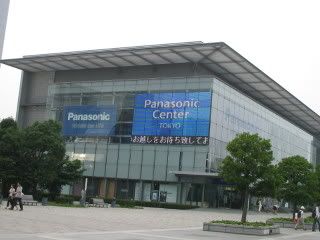
Prior to that, we went to Panasonic Center, the place where Panasonic showcases their latest products as well as educating the public on their innovations and their contributions towards maintaining a sustainable environment. I liked it. Hubby enjoyed it. Even Huzaifah was not easily bored since they had lots of different areas with different features and displays. We also happened to be there on the first day Panasonic decided to distribute some souvenirs of the Osaka Gamba, a soccer club receiving their sponsorship. So, after completing stamp marking the three forms at 4 different areas of the 2-floor hall, we went to claim our souvenirs. The muffler and the t-shirt looked pretty cool, but we only managed to get two note-books and a lousy eraser.
In conjunction with Tanabata, there were assistants in traditional yukata, distributing papers to be hung as both decorations and wishes on bamboo trees on the far-end corner of the spacious building. Tanabata, a celebration which originated from China, is supposed to be one of the most romantic days celebrated in Japan, and according to my Nihongo sensei, due to its history, in the old days, people used to hope for romantic wishy-washy stuff on Tanabata. Nowadays, the wishes written on paper strips hung on bamboo trees are for various purposes – safety, health, wealth, promotion, being accepted by university – to name a few. Kindergarten kids who were there were encouraged to make various decorations, with all the necessities – papers of various colors and sizes, glue, scissors, wet tissue, tissue – being provided. Mothers assisted and waited patiently by their children as they earnestly worked on their very own Tanabata decoration project.
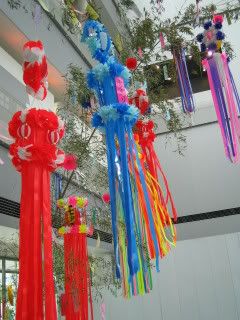
We were keener on seizing the opportunity to take photos with the colorful oh-so-Japanese-scenic background. We even had two photo postcards printed there courtesy of Panasonic – and I really love the one with two Nihonjin girls in yukata, with me holding Huzaifah on the center making peace sign a’la Nihonjin pose. (Seriously – in Japan, people of all ages - from kindergarten kids to grandpa - just love making peace sign while posing for the camera). Too bad hubby didn’t snap that pose on our own camera.
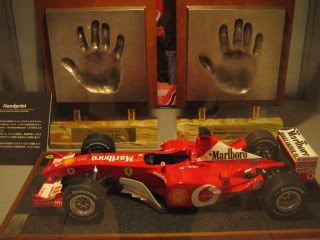
From Kokusai Tenjijo, we went to Daiba, to Shell Museum. No, it is not a museum featuring sea shells, rather it features Shell-Ferrari F1 collaboration. It was closed on Saturdays (open everyday but Saturdays. Duh!), so we just took some pictures of what was visible – pictures on the wall, Schumacher’s hand prints, bridgestone tyre used at one of the F1 races in 2004, etc. No F1 racing car though on display though – that’s reserved only when the museum-café is open. Hubby was so engrossed in taking photos that he didn’t realize that he already went beyond the allowed area and set off the sensor alarm. An elderly Nihonjin Pak Guard on duty came to check what had set off the alarm and when he saw we were snapping some photos, politely advised us to be careful since the sensors in the area were rather sensitive. I was a bit embarrassed – yelah, baru gambar kadbod Schumacher je, bukannya dengan Schumacher in person pun dah excited tangkap gambar sampai bunyi alarm, heheheh…

Aqua City was our last stop, stopping at Deck’s on our way there. Many shops were having summer sale – Gap, Comme Ca Ism, Next - to name a few. No, I am not a brand conscious person, but if I can get a 600 or 900 yen items for Huzaifah at branded stores while they are on sale, I wouldn’t mind buying them compared to paying the same amount for items with questionable quality elsewhere.
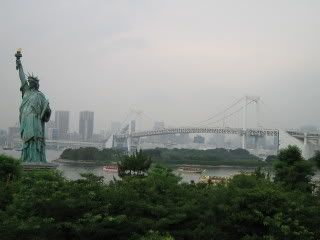
We returned at dusk, bidding farewell to the Odaiba’s Statue of Liberty and the colorful nicely lighted-up boats with lighted-up Rainbow Bridge in the background. Our feet ached from all the walking we did, but all in all, I would say that we had fun. Even Huzaifah seemed to enjoy his day out very much.
Oh, by the by, I managed to snap some photos of summer gifts, also known as chugen, or mid-year gift. Wikipedia said that it's celebrated on July 15th, but I have been told that it started as early as late June and ends as late as early August. There’s a Japanese saying that claims “siblings are the beginning of strangers”, thus an anthropologist professor of mine claimed that, the chugen gift custom is a chance for people to make up for not meeting or calling relatives and friends often, yet still maintaining good relationship with them. A Nihonjin friend offered a simpler reason though – since summer is always blazing hot, everybody just gives everybody else some gifts to cool each other down. Yeah, that’s why a lot of Nihonjin send fruits, soft drinks, tea leaves and instant coffee powder in nicely decorated boxes as chugen gift. Sometimes they even send cooking oil as chugen gift – to fry tempuras or prepare yakisoba to be consumed together with cold drinks.


I was thinking of sending a gift to Kawaguchi sensei who wrote the recommendation letter for my Waseda application. However, since chugen gift receiver usually feels obliged to give something in return to the sender, chugen might not be the best time for me to send a gift to Kawaguchi sensei. Hmm, maybe I should get something from Malaysia as a simple thank-you gift. But what should I get him, huh?
Went to Shimbashi and bought one-day ticket for Yurikamome line, which had always reminded me of Putra LRT, except that they still have lots of seats in Yurikamome trains. First we went to Kokusaitenjijo-seimon. A lot of people were there to attend the Tokyo International Book Fair 2006 – incorporating, among others, Digital Fair, Gifts and Variety Fair and Education Book Fair. Unlike KL International Book Fair with no entrance fee, there’s an entrance fee of 1200 yen each for those who came to Tokyo International Book Fair without any invitation. Everyone is duly registered, by completing a long registration form and attaching 2 business cards. No, one does not have to be an executive to have a business card here since even housewives in Japan carry their meishi (business cards) in their purses. Many students in Waseda have business cards too, often self-made and printed by computer printers, rather than being made by a proper business-card printer.
Anyway, we only discovered that we needed to pay and submit our business card (non-existent at the moment) only after we had walked all the way to the halls where the exhibition was held, and since I was only hoping for a glance at the books with no intention of buying anything, we decided not to go inside after all. Anyway, we saw lots of people carrying goodie bags, but many of them were busy disposing a lot of brochures and pamphlets at the entrance, perhaps unwilling to carry unnecessary ‘garbage’ all the way back home (probably by train or other public transports.)
Prior to that, we went to Panasonic Center, the place where Panasonic showcases their latest products as well as educating the public on their innovations and their contributions towards maintaining a sustainable environment. I liked it. Hubby enjoyed it. Even Huzaifah was not easily bored since they had lots of different areas with different features and displays. We also happened to be there on the first day Panasonic decided to distribute some souvenirs of the Osaka Gamba, a soccer club receiving their sponsorship. So, after completing stamp marking the three forms at 4 different areas of the 2-floor hall, we went to claim our souvenirs. The muffler and the t-shirt looked pretty cool, but we only managed to get two note-books and a lousy eraser.
In conjunction with Tanabata, there were assistants in traditional yukata, distributing papers to be hung as both decorations and wishes on bamboo trees on the far-end corner of the spacious building. Tanabata, a celebration which originated from China, is supposed to be one of the most romantic days celebrated in Japan, and according to my Nihongo sensei, due to its history, in the old days, people used to hope for romantic wishy-washy stuff on Tanabata. Nowadays, the wishes written on paper strips hung on bamboo trees are for various purposes – safety, health, wealth, promotion, being accepted by university – to name a few. Kindergarten kids who were there were encouraged to make various decorations, with all the necessities – papers of various colors and sizes, glue, scissors, wet tissue, tissue – being provided. Mothers assisted and waited patiently by their children as they earnestly worked on their very own Tanabata decoration project.
We were keener on seizing the opportunity to take photos with the colorful oh-so-Japanese-scenic background. We even had two photo postcards printed there courtesy of Panasonic – and I really love the one with two Nihonjin girls in yukata, with me holding Huzaifah on the center making peace sign a’la Nihonjin pose. (Seriously – in Japan, people of all ages - from kindergarten kids to grandpa - just love making peace sign while posing for the camera). Too bad hubby didn’t snap that pose on our own camera.
From Kokusai Tenjijo, we went to Daiba, to Shell Museum. No, it is not a museum featuring sea shells, rather it features Shell-Ferrari F1 collaboration. It was closed on Saturdays (open everyday but Saturdays. Duh!), so we just took some pictures of what was visible – pictures on the wall, Schumacher’s hand prints, bridgestone tyre used at one of the F1 races in 2004, etc. No F1 racing car though on display though – that’s reserved only when the museum-café is open. Hubby was so engrossed in taking photos that he didn’t realize that he already went beyond the allowed area and set off the sensor alarm. An elderly Nihonjin Pak Guard on duty came to check what had set off the alarm and when he saw we were snapping some photos, politely advised us to be careful since the sensors in the area were rather sensitive. I was a bit embarrassed – yelah, baru gambar kadbod Schumacher je, bukannya dengan Schumacher in person pun dah excited tangkap gambar sampai bunyi alarm, heheheh…
Aqua City was our last stop, stopping at Deck’s on our way there. Many shops were having summer sale – Gap, Comme Ca Ism, Next - to name a few. No, I am not a brand conscious person, but if I can get a 600 or 900 yen items for Huzaifah at branded stores while they are on sale, I wouldn’t mind buying them compared to paying the same amount for items with questionable quality elsewhere.
We returned at dusk, bidding farewell to the Odaiba’s Statue of Liberty and the colorful nicely lighted-up boats with lighted-up Rainbow Bridge in the background. Our feet ached from all the walking we did, but all in all, I would say that we had fun. Even Huzaifah seemed to enjoy his day out very much.
Oh, by the by, I managed to snap some photos of summer gifts, also known as chugen, or mid-year gift. Wikipedia said that it's celebrated on July 15th, but I have been told that it started as early as late June and ends as late as early August. There’s a Japanese saying that claims “siblings are the beginning of strangers”, thus an anthropologist professor of mine claimed that, the chugen gift custom is a chance for people to make up for not meeting or calling relatives and friends often, yet still maintaining good relationship with them. A Nihonjin friend offered a simpler reason though – since summer is always blazing hot, everybody just gives everybody else some gifts to cool each other down. Yeah, that’s why a lot of Nihonjin send fruits, soft drinks, tea leaves and instant coffee powder in nicely decorated boxes as chugen gift. Sometimes they even send cooking oil as chugen gift – to fry tempuras or prepare yakisoba to be consumed together with cold drinks.
I was thinking of sending a gift to Kawaguchi sensei who wrote the recommendation letter for my Waseda application. However, since chugen gift receiver usually feels obliged to give something in return to the sender, chugen might not be the best time for me to send a gift to Kawaguchi sensei. Hmm, maybe I should get something from Malaysia as a simple thank-you gift. But what should I get him, huh?
Sunday, July 09, 2006
Isn't that a blessing?
Dear Kakaq and Ahkak,
Went to UniQlo last week and one nice olive fitting t-shirt in the sale bin caught my attention. Its caption reads:
“I have a glorious life. I can do anything I want, go
where I want, be alone if I want, travel if I want
and sometimes I don’t want anything
Now isn’t that a blessing?”
I found it kawaii just like the two prayers.
While I know it doesn’t apply to me anymore (what with a 10-month-old baby who is going through a rather critical stage of separation anxiety – nak pergi tandas pun punyalah susah),
I bought it anyway.
Went to UniQlo last week and one nice olive fitting t-shirt in the sale bin caught my attention. Its caption reads:
“I have a glorious life. I can do anything I want, go
where I want, be alone if I want, travel if I want
and sometimes I don’t want anything
Now isn’t that a blessing?”
I found it kawaii just like the two prayers.
While I know it doesn’t apply to me anymore (what with a 10-month-old baby who is going through a rather critical stage of separation anxiety – nak pergi tandas pun punyalah susah),
I bought it anyway.
Friday, July 07, 2006
Re: A Request - Denied
Assalamu Alaikum.
I am muslim.I was eagerly looking for a japanese muslimah.I did complete my Masters in Computer Science and just join in a company. I have found japanese people arevery polite and they have a very good hospitality.Sometimes I feel very sad why they still do not enter in Islam. Itwould be very great for them. In world japanese products are very famous and japanese people are doing hard to supply the good items. But why they are not receiving the most essential thing (ISLAM)??
Secondly, i have found many times converted muslimsare more pious than by born muslims. So, I am lookingfor japanese converted muslimah for my life partner.Would you please help me in this purpose...
May Allah bless you. Allah Hafiz
#####
Dear Brother B,
If you are interested in finding a Japanese Muslimah to be your life partner, I may not be the best person to introduce you to one. Honestly, I have never been quite successful in matchmaking people. More importantly I would NEVER introduce some stranger to a worthy colleague of mine . You might have a Masters degree, a good job and maybe even not bad looking – but this thing called ‘life partnership’ is not just about the above-mentioned. There’s this thing called ‘personality’, and there’s another thing called ‘compatability’ and yes, there’s also that thing called ‘the One factors’.
Personality includes traits such as kindness, honesty, trustworthiness, understanding, caring blah blah blah. Compatibility is where one looks at the chances of two being able to pull it through as a couple – their similar or differing opinions in outlook of life, hobbies, financial standing, family background, blah blah blah. As for “the One factors”, they differs for different individuals – but these are the major criteria they look for in their partner. Some may look for high education, good pay and good look while others look for charisma and a good sense of humor, while there are yet who simply look for a "good, religious person", whatever that may entails.
After having listened to horror stories of foreigner husbands – I’m sorry, but this is what I’ve gathered so far - mostly of Pakistani origin, I’m definitely not keen on introducing yet another to an innocent Japanese muslimah. What if you are just interested in marrying a Japanese to ensure you get spousal visa? What if you are just interested in marrying a Japanese for financial gains? What guarantees can you give that you are sincere in marrying a new revert? That once married, you will never abandon her, instead, love her with all your heart and soul and take good care of her until death do you part? I don't know you and therefore I'm not going to take any uncalculated risk...
Yes, I agree that there are many muslim reverts who more pious than born muslims. That’s why it’s scary sometimes to think how many born muslims have spoiled the chances of nurturing another good muslim by not properly educating nor setting good examples for their muslim-revert partners. What guarantee can you give that you will not fall into the same category with other born muslims I have seen who has not taken up the responsibility to educate their wife themselves, or to at least send their wife for proper education in Islam?
I am sure you have met many Pakistani friends here who have married Japanese muslimah. Perhaps you stand a better chance to seek a single Japanese muslimah through your connection with them. If you are indeed sincere in building up a life with a pious Japanese muslimah in this country, I wish you all the best and may Allah guide you and bless you in your endeavor. (Otherwise, I pray that Allah protect all single Japanese muslimah from any potential hazards)
Yours sincerely,
A.Z. Haida
I am muslim.I was eagerly looking for a japanese muslimah.I did complete my Masters in Computer Science and just join in a company. I have found japanese people arevery polite and they have a very good hospitality.Sometimes I feel very sad why they still do not enter in Islam. Itwould be very great for them. In world japanese products are very famous and japanese people are doing hard to supply the good items. But why they are not receiving the most essential thing (ISLAM)??
Secondly, i have found many times converted muslimsare more pious than by born muslims. So, I am lookingfor japanese converted muslimah for my life partner.Would you please help me in this purpose...
May Allah bless you. Allah Hafiz
#####
Dear Brother B,
If you are interested in finding a Japanese Muslimah to be your life partner, I may not be the best person to introduce you to one. Honestly, I have never been quite successful in matchmaking people. More importantly I would NEVER introduce some stranger to a worthy colleague of mine . You might have a Masters degree, a good job and maybe even not bad looking – but this thing called ‘life partnership’ is not just about the above-mentioned. There’s this thing called ‘personality’, and there’s another thing called ‘compatability’ and yes, there’s also that thing called ‘the One factors’.
Personality includes traits such as kindness, honesty, trustworthiness, understanding, caring blah blah blah. Compatibility is where one looks at the chances of two being able to pull it through as a couple – their similar or differing opinions in outlook of life, hobbies, financial standing, family background, blah blah blah. As for “the One factors”, they differs for different individuals – but these are the major criteria they look for in their partner. Some may look for high education, good pay and good look while others look for charisma and a good sense of humor, while there are yet who simply look for a "good, religious person", whatever that may entails.
After having listened to horror stories of foreigner husbands – I’m sorry, but this is what I’ve gathered so far - mostly of Pakistani origin, I’m definitely not keen on introducing yet another to an innocent Japanese muslimah. What if you are just interested in marrying a Japanese to ensure you get spousal visa? What if you are just interested in marrying a Japanese for financial gains? What guarantees can you give that you are sincere in marrying a new revert? That once married, you will never abandon her, instead, love her with all your heart and soul and take good care of her until death do you part? I don't know you and therefore I'm not going to take any uncalculated risk...
Yes, I agree that there are many muslim reverts who more pious than born muslims. That’s why it’s scary sometimes to think how many born muslims have spoiled the chances of nurturing another good muslim by not properly educating nor setting good examples for their muslim-revert partners. What guarantee can you give that you will not fall into the same category with other born muslims I have seen who has not taken up the responsibility to educate their wife themselves, or to at least send their wife for proper education in Islam?
I am sure you have met many Pakistani friends here who have married Japanese muslimah. Perhaps you stand a better chance to seek a single Japanese muslimah through your connection with them. If you are indeed sincere in building up a life with a pious Japanese muslimah in this country, I wish you all the best and may Allah guide you and bless you in your endeavor. (Otherwise, I pray that Allah protect all single Japanese muslimah from any potential hazards)
Yours sincerely,
A.Z. Haida
Tuesday, July 04, 2006
One quiet mosque
“Jom solat kat bawah” means hubby wants me to join him two floors below, praying at the mosque. He seldom gets any makmum on working days. Normally there’s an Indonesian who prays Zohor and Asar here and, there’s a Pakistani at Isyak. That’s it – a total of two makmums in a day, sometimes just one, if one of them doesn't show up.
This mosque is nothing like a typical mosque in Malaysia. I mean, seriously, can anyone name a mosque in Malaysia which is located opposite a Sports Toto shop? As for us, we are getting used to seeing the long queues of obaachan and ojiichan buying Loto lottery ticket at the stall right in front of the mosque.
The jumu’ah prayer normally has less than 40 male makmums, but then, this part of Tokyo is not exactly buzzing with people. Asakusa is rather secluded, filled up with mostly elderly, living on their own, because it’s not customary anymore for the elderly to be looked after by their children. Note that I used ‘elderly’, not ‘old’ because in Japan, people neither get ‘old’ nor ‘fat’. Hence it’s normal to find obaachan (grandma), errr, I mean obachan (auntie), who dyed their hair garish purple, refusing to sit when a younger one offer his or her seat on the train for them. They try their best not to look frail in any way - 'nicely' made-up with thick layer of foundation and bright lipstick, wearing a'la Sophia Loren sunglasses with blouses and matching jackets that screamed ‘custom-made’. Even if they have to ride a tricycle instead of a bicycle, no they don’t exactly look ‘frail’.
Anyway, back to the mosque.
Did I mention that we receive weekly female congregation for jumu’ah? Oh yes, we do. New muslim sisters normally used to go to their jinja (shrine) to pray. Or even when they are at home, they used to have a special area for ‘spiritual’ activities. And since modern Japanese are not usually very 'spiritual', that means they are not used to praying often. The concept that one can pray anywhere, any place, at specific times day in day out used to be a foreign concept to them when they first discovered Islam. Some of them find it difficult to pray five times a day alone at home, so they make it a habit to at least come and pray once a week at the mosque. Of course, some of the sisters who attend the jumu’ah prayer do pray five times a day at their home, but at least for those who need morale support, this is where they come to every week.
Wassim, the Pakistani guy who tries to be at the mosque for Isyak daily, once told hubby that this mosque used to be rather popular about five or six years ago, but things changed drastically after September 11. Taking their cue from their ‘big brother’ in the US, the police in Japan raised their alert for any sign of ‘Muslim terrorists’ hiding in Japan. That meant increased police patrol near mosques areas. And a lot of people going to the mosques were stopped, their Alien Card checked and rechecked. Some were detained for further questioning upon finding that they had overstayed, others were simply harrased for simple stuff such as the ownership of their bikes (which they received from their friends who had left Japan, and thus they were not the ‘legal’ owner of the bike as recognized by the Japanese law).
The mosque used to have people coming from as far as Kita Senju, two towns away from Higashi Asakusa. But after September 11, after being subject to close scrutiny of policemen from the nearby Koban (police kiosk), people stopped coming ever since.
Hubby is trying to figure out how to imarahkan this mosque once again. Instead of going to Gyotoku, he’s thinking of holding a biweekly Islamic discussion (not limited to Fardhu Ain stuff only) here in this mosque. Yet at the same time he’s worried that people might not come since Asakusa is a bit remote. He’s been trying to invite others to make use of the BBQ facility at this mosque’s rooftop. He’s been trying to promote the usage of this mosque for any gathering or Islamic discussion, but has yet to receive any favorable response.
This is definitely one quiet mosque.
This mosque is nothing like a typical mosque in Malaysia. I mean, seriously, can anyone name a mosque in Malaysia which is located opposite a Sports Toto shop? As for us, we are getting used to seeing the long queues of obaachan and ojiichan buying Loto lottery ticket at the stall right in front of the mosque.
The jumu’ah prayer normally has less than 40 male makmums, but then, this part of Tokyo is not exactly buzzing with people. Asakusa is rather secluded, filled up with mostly elderly, living on their own, because it’s not customary anymore for the elderly to be looked after by their children. Note that I used ‘elderly’, not ‘old’ because in Japan, people neither get ‘old’ nor ‘fat’. Hence it’s normal to find obaachan (grandma), errr, I mean obachan (auntie), who dyed their hair garish purple, refusing to sit when a younger one offer his or her seat on the train for them. They try their best not to look frail in any way - 'nicely' made-up with thick layer of foundation and bright lipstick, wearing a'la Sophia Loren sunglasses with blouses and matching jackets that screamed ‘custom-made’. Even if they have to ride a tricycle instead of a bicycle, no they don’t exactly look ‘frail’.
Anyway, back to the mosque.
Did I mention that we receive weekly female congregation for jumu’ah? Oh yes, we do. New muslim sisters normally used to go to their jinja (shrine) to pray. Or even when they are at home, they used to have a special area for ‘spiritual’ activities. And since modern Japanese are not usually very 'spiritual', that means they are not used to praying often. The concept that one can pray anywhere, any place, at specific times day in day out used to be a foreign concept to them when they first discovered Islam. Some of them find it difficult to pray five times a day alone at home, so they make it a habit to at least come and pray once a week at the mosque. Of course, some of the sisters who attend the jumu’ah prayer do pray five times a day at their home, but at least for those who need morale support, this is where they come to every week.
Wassim, the Pakistani guy who tries to be at the mosque for Isyak daily, once told hubby that this mosque used to be rather popular about five or six years ago, but things changed drastically after September 11. Taking their cue from their ‘big brother’ in the US, the police in Japan raised their alert for any sign of ‘Muslim terrorists’ hiding in Japan. That meant increased police patrol near mosques areas. And a lot of people going to the mosques were stopped, their Alien Card checked and rechecked. Some were detained for further questioning upon finding that they had overstayed, others were simply harrased for simple stuff such as the ownership of their bikes (which they received from their friends who had left Japan, and thus they were not the ‘legal’ owner of the bike as recognized by the Japanese law).
The mosque used to have people coming from as far as Kita Senju, two towns away from Higashi Asakusa. But after September 11, after being subject to close scrutiny of policemen from the nearby Koban (police kiosk), people stopped coming ever since.
Hubby is trying to figure out how to imarahkan this mosque once again. Instead of going to Gyotoku, he’s thinking of holding a biweekly Islamic discussion (not limited to Fardhu Ain stuff only) here in this mosque. Yet at the same time he’s worried that people might not come since Asakusa is a bit remote. He’s been trying to invite others to make use of the BBQ facility at this mosque’s rooftop. He’s been trying to promote the usage of this mosque for any gathering or Islamic discussion, but has yet to receive any favorable response.
This is definitely one quiet mosque.
Monday, July 03, 2006
High Tea in Hilton
Kamarol called me Saturday at around noon, “Jom, pegi high tea kat Hilton, aku belanja.”
I just laughed at his feeble attempt of trick, since I was aware that the Malaysian Embassy would be organizing one such function in conjunction with a Minister’s visit. Kamarol was invited by Nafisah, the girl in charge of Human Resources at the Embassy, who asked him to invite others as well since there were still vacancies for the tables booked at the hotel.
Consulted hubby and he said ok. “Jumpa pukul 4.30 kat lobby Hilton. Jangan lewat. Jangan Menteri lak yang tunggu engkau,” Kamarol warned.
The thing is, I have known about this high-tea some time ago, but was not initially interested in joining because of two reasons – one, reluctance to bring Huzaifah to such function; two, because hubby has to teach some kids at 3.00 p.m, which normally ends at 4.00 p.m., and so I was worried that we might not be able to be there in time.
Just then, the mother of the hubby’s Pakistani-Nihonjin students called us, saying that she would like to have a change of schedule this week and is 10.00 o’clock Sunday morning okay with us? We said okay and I was glad that it seemed we would be able to be in time after all.
But at 2.15 p.m, the mother called again, telling me that oops, tomorrow is not okay, and they would be at the mosque at 3.00 p.m. today, as usual.
I got ready, preparing Huzaifah as well. Asked hubby if he brought any suit to Tokyo, he said no, and no, he wasn’t keen on wearing a suit although I advised him that the function would be a formal one. Hubby said he would take his chances by just wearing a black working shirt and if he’s not allowed to enter the function, then he’ll just return home. I know better than to further argue with him, after all I can’t help but agreeing with hubby’s claim that some people take all the trouble to dress up to meet orang besar but not caring much what they wear when they meet Yang Maha Besar.
We were late. At 4.00 p.m., hubby was in the middle of giving shukudai to the kids, and he hadn’t pray Asar yet. Huzaifah and I waited as he wrapped up the class and prayed Asar. At about 4.30 p.m., we boarded the train from Asakusa to Nishi Shinjuku, transferring once to Marunouchi line at Akasaka Mitsuke. Prior to that, I sent a c-mail to Kamarol, advising him to go ahead and join other people because I had no idea when we would arrive at Hilton.
We arrived at Nishi Shinjuku eki at about 5.10. Kamarol told us that there’s an exit to Hilton from Nishi Shinjuku eki but we used another exit by mistake. As a result, it took us 15 minutes to reach Hilton, and along the way hubby was busy snapping photos although I insisted on quickening our pace.
Yes, we were very late, and Datuk Seri Shahrizat had almost came to the ending of her speech as we were ushered to the far end corner of the ballroom. Hubby realized he was really the odd one out as every other guy in the ballroom seemed to be wearing either suits or batik, while he even wore casual slack. I almost said “I told you so” but decided not to. Let him learn his own lesson.
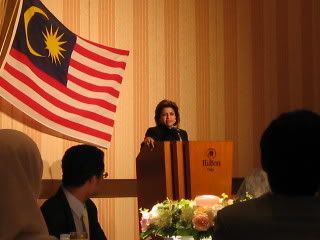
It wasn’t long before the MC declared “jemputlah makan” (instead of the more polite expression of “silalah menjamu selera”) and everybody made their way to the buffet table. Hubby and I opted to go straight to the snacks and dessert tables since we were both still full from eating my first attempt of beriani rice (using Maggi instant flavor) and Bombay beriani mutton (Ahmed’s spice) with the normal jelatah.
Huzaifah had lots and lots of pastry and cake (because it’s easier and less messy to feed him such food), while I had my fair share of satay, California rolls and strawberries. There was a chocolate fountain (instead of dip) for the fruit slices (melon, strawberries and pineapples – mind you, all these three are expensive fruits here though pineapples and melons are not that expensive in Malaysia), but I have never been a chocolate lover anyway, so it was not a big deal for me. Nevertheless I noticed a lot of girls appeared to be mesmerized by that chocolate fountain, leaving lots of the cake, pudding and tarts untouched to my delight. And I did not miss much for not taking rice, because according to Apid, the only tasty lauk was the ayam masak kicap, and I can cook a decent ayam masak kicap myself. I was really glad to see satay though since I have been missing them greatly due to the fact that yakitori is a popular summer snack around here.
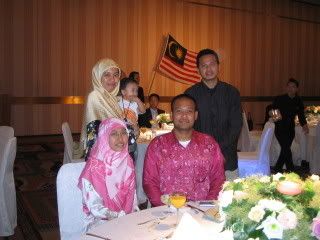
Huzaifah was the only baby present and I was really glad that he behaved well throughout the whole evening. You can never tell with babies, they can throw tantrum in a matter of minutes and the cutest baby can turn into a frightful monster. Alhamdulillah Huzaifah chose to be rather quiet; perhaps a bit overwhelmed since he’s not used to seeing lots of people gathering in a dim place. Lots of people came to play with or hold him – including the Minister, some big shots, but mostly undergraduate students, both male and female. Huzaifah used to prefer playing with oniisan than oneesan, but nowadays, since he had gotten the separation anxiety thingy, he refused to be held by others for long.
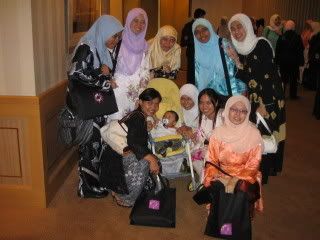
I took the opportunity to look for other postgraduate student who were attending the function apart from Kamarol. Someone pointed out two girls, both named Ina - one doing her Masters and the other pursuing her PhD. Since the Ina who was pursuing Masters was busy taking picture, I asked to be introduced to the other Ina. And hey, turned out she reads my blog regularly and need not much introduction because she pretty much knew me already. Or my blogger self, anyway.
According to her, she’s been an avid reader of my blog for a long time. In fact she had seen and recognized me when I went for Aidilfitri prayer at the Embassy last year but was rather shy to say hi to me. Well, it did felt rather weird to hear a perfect stranger recalling what I’ve written on my blog in front of me, but coming from her, it sounded friendly as against frightening (“macam stalker” as Apid put it) Anyway Ina, hope you’ll keep on being my reader and yes I am going to find out your blog too soon. It’s a small blogging world after all. And though I am serious about the invitation for Hanabi session and Tobu World Square, I forgot to get your contact details amidst our chat, so please feel free to email me your details, okay?
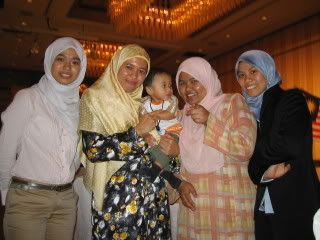
I was looking for Pak Abas, a former SUB at my old office who is now the TKSU at Datuk Shahrizat’s ministry. Unfortunately he was not around, so I sent my regards to him through an officer named Hasnah, who used to study in Tokyo and lived in Ichikawaono. It would be good to meet Pak Abas – he was one of the fatherly figures we had in the office apart from ayahanda (Dato’) Nadzim, who retired as Deputy State Secretary of Perak. They both helped giving the office some positive ambiance with their generosity and I believe, despite their shortcomings, they would always be remembered kindly by those who used to work under their supervision.
Anyway, the high-tea ended with goodies being handed out – courtesy of Malaysian delegation. We each got a bag consisting a packet of keropok, serunding daging, and the integrated encyclopedia of the Holy Quran CD-Rom plus the unavoidable brochure of the Malaysian Ministry of Women, Family and Community Development.
Hubby spent some time chatting with his own peers – those working under Education scheme. “Aku dah jumpa geng aku. Kau tak yah berlagak, kat sini takdak PTD.Kami semua DG,” Kamarol stated. They even took a group photo chanting “D-G” instead of the normal “chii-zu”.
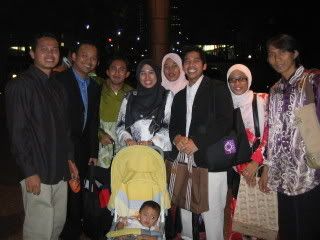
All in all, a tiring day, but the less-than-a-thousand yen hubby and I spent to go there was definitely worth it.
I just laughed at his feeble attempt of trick, since I was aware that the Malaysian Embassy would be organizing one such function in conjunction with a Minister’s visit. Kamarol was invited by Nafisah, the girl in charge of Human Resources at the Embassy, who asked him to invite others as well since there were still vacancies for the tables booked at the hotel.
Consulted hubby and he said ok. “Jumpa pukul 4.30 kat lobby Hilton. Jangan lewat. Jangan Menteri lak yang tunggu engkau,” Kamarol warned.
The thing is, I have known about this high-tea some time ago, but was not initially interested in joining because of two reasons – one, reluctance to bring Huzaifah to such function; two, because hubby has to teach some kids at 3.00 p.m, which normally ends at 4.00 p.m., and so I was worried that we might not be able to be there in time.
Just then, the mother of the hubby’s Pakistani-Nihonjin students called us, saying that she would like to have a change of schedule this week and is 10.00 o’clock Sunday morning okay with us? We said okay and I was glad that it seemed we would be able to be in time after all.
But at 2.15 p.m, the mother called again, telling me that oops, tomorrow is not okay, and they would be at the mosque at 3.00 p.m. today, as usual.
I got ready, preparing Huzaifah as well. Asked hubby if he brought any suit to Tokyo, he said no, and no, he wasn’t keen on wearing a suit although I advised him that the function would be a formal one. Hubby said he would take his chances by just wearing a black working shirt and if he’s not allowed to enter the function, then he’ll just return home. I know better than to further argue with him, after all I can’t help but agreeing with hubby’s claim that some people take all the trouble to dress up to meet orang besar but not caring much what they wear when they meet Yang Maha Besar.
We were late. At 4.00 p.m., hubby was in the middle of giving shukudai to the kids, and he hadn’t pray Asar yet. Huzaifah and I waited as he wrapped up the class and prayed Asar. At about 4.30 p.m., we boarded the train from Asakusa to Nishi Shinjuku, transferring once to Marunouchi line at Akasaka Mitsuke. Prior to that, I sent a c-mail to Kamarol, advising him to go ahead and join other people because I had no idea when we would arrive at Hilton.
We arrived at Nishi Shinjuku eki at about 5.10. Kamarol told us that there’s an exit to Hilton from Nishi Shinjuku eki but we used another exit by mistake. As a result, it took us 15 minutes to reach Hilton, and along the way hubby was busy snapping photos although I insisted on quickening our pace.
Yes, we were very late, and Datuk Seri Shahrizat had almost came to the ending of her speech as we were ushered to the far end corner of the ballroom. Hubby realized he was really the odd one out as every other guy in the ballroom seemed to be wearing either suits or batik, while he even wore casual slack. I almost said “I told you so” but decided not to. Let him learn his own lesson.
"Our students in Japan must have been the smartest, most brilliant, prettiest, gorgeous, bla, bla, bla.... (insert typical bodek by politicians)"
It wasn’t long before the MC declared “jemputlah makan” (instead of the more polite expression of “silalah menjamu selera”) and everybody made their way to the buffet table. Hubby and I opted to go straight to the snacks and dessert tables since we were both still full from eating my first attempt of beriani rice (using Maggi instant flavor) and Bombay beriani mutton (Ahmed’s spice) with the normal jelatah.
Huzaifah had lots and lots of pastry and cake (because it’s easier and less messy to feed him such food), while I had my fair share of satay, California rolls and strawberries. There was a chocolate fountain (instead of dip) for the fruit slices (melon, strawberries and pineapples – mind you, all these three are expensive fruits here though pineapples and melons are not that expensive in Malaysia), but I have never been a chocolate lover anyway, so it was not a big deal for me. Nevertheless I noticed a lot of girls appeared to be mesmerized by that chocolate fountain, leaving lots of the cake, pudding and tarts untouched to my delight. And I did not miss much for not taking rice, because according to Apid, the only tasty lauk was the ayam masak kicap, and I can cook a decent ayam masak kicap myself. I was really glad to see satay though since I have been missing them greatly due to the fact that yakitori is a popular summer snack around here.
With Hisyam, a postgraduate under UNIMAS Sponsorship and his wife Wani
Huzaifah was the only baby present and I was really glad that he behaved well throughout the whole evening. You can never tell with babies, they can throw tantrum in a matter of minutes and the cutest baby can turn into a frightful monster. Alhamdulillah Huzaifah chose to be rather quiet; perhaps a bit overwhelmed since he’s not used to seeing lots of people gathering in a dim place. Lots of people came to play with or hold him – including the Minister, some big shots, but mostly undergraduate students, both male and female. Huzaifah used to prefer playing with oniisan than oneesan, but nowadays, since he had gotten the separation anxiety thingy, he refused to be held by others for long.
Huzaifah being mugged with attention every now and then
I took the opportunity to look for other postgraduate student who were attending the function apart from Kamarol. Someone pointed out two girls, both named Ina - one doing her Masters and the other pursuing her PhD. Since the Ina who was pursuing Masters was busy taking picture, I asked to be introduced to the other Ina. And hey, turned out she reads my blog regularly and need not much introduction because she pretty much knew me already. Or my blogger self, anyway.
According to her, she’s been an avid reader of my blog for a long time. In fact she had seen and recognized me when I went for Aidilfitri prayer at the Embassy last year but was rather shy to say hi to me. Well, it did felt rather weird to hear a perfect stranger recalling what I’ve written on my blog in front of me, but coming from her, it sounded friendly as against frightening (“macam stalker” as Apid put it) Anyway Ina, hope you’ll keep on being my reader and yes I am going to find out your blog too soon. It’s a small blogging world after all. And though I am serious about the invitation for Hanabi session and Tobu World Square, I forgot to get your contact details amidst our chat, so please feel free to email me your details, okay?
One for the album - Ina, her two kohai, Huzaifah and I
I was looking for Pak Abas, a former SUB at my old office who is now the TKSU at Datuk Shahrizat’s ministry. Unfortunately he was not around, so I sent my regards to him through an officer named Hasnah, who used to study in Tokyo and lived in Ichikawaono. It would be good to meet Pak Abas – he was one of the fatherly figures we had in the office apart from ayahanda (Dato’) Nadzim, who retired as Deputy State Secretary of Perak. They both helped giving the office some positive ambiance with their generosity and I believe, despite their shortcomings, they would always be remembered kindly by those who used to work under their supervision.
Anyway, the high-tea ended with goodies being handed out – courtesy of Malaysian delegation. We each got a bag consisting a packet of keropok, serunding daging, and the integrated encyclopedia of the Holy Quran CD-Rom plus the unavoidable brochure of the Malaysian Ministry of Women, Family and Community Development.
Hubby spent some time chatting with his own peers – those working under Education scheme. “Aku dah jumpa geng aku. Kau tak yah berlagak, kat sini takdak PTD.Kami semua DG,” Kamarol stated. They even took a group photo chanting “D-G” instead of the normal “chii-zu”.
"Dee Gee..."
"Gaya seorang penghibur jalanan"
All in all, a tiring day, but the less-than-a-thousand yen hubby and I spent to go there was definitely worth it.
A Swedish Tourist in Asakusa
Once in a while, this mosque we call home, receives guests other than the normal Jumu’ah congregation. Last Friday, it was Ertan, a Swedish with Kosovan Albanian origin, who has married a Swedish who’s half Japanese. He and his newlywed wife are in Japan to visit his wife relatives, staying in Tokyo and Osaka for about 2 weeks.
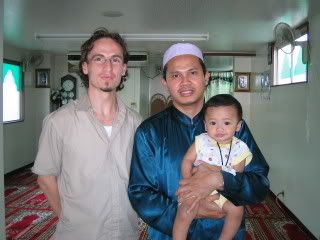
Hubby invited him to our home for tea and they had a long exchange on Muslims in both Japan and Sweden. Ertan used to work in a school and is worried about the future of Muslim children who are being sent to public schools. “They are being taught that their parents has no right to touch them, that they can always report to the agency involved if there’s so much as a tap at the back of their hand. I have seen a Muslim mother being sent to jail for 6 months because her child called the agency after she hit the child’s hand. That’s not right. Parents have the right to discipline their children, within reasons, so long as the children are not harmed.”
Yes, while it’s true that no child should be abused, parents should be allowed some space to use some measure of punishment, including hitting within reason, to discipline their children. I’ve seen destructive children creating havoc in other people’s houses and their parents never said anything just because they feel that their children must be given the freedom to do whatever they want to do in order not to disrupt their creativity. I guess, there must be balance in everything – while I support that children must be allowed some freedom to advance their creativity, it’s important too to instill respect for others, especially adults.
Since it was only Ertan’s second day in Tokyo, hubby asked if he would like to tour around Asakusa since we were thinking of going out anyway, we might as well be his tourist guide. Ertan was glad to hear that and so we went to Asakusa together after Asar, on bicycles (hubby gave Ertan a ride on the back of his bike until we reached Asakusa, which is illegal, but we hoped that we could get away with it and alhamdulillah we did)
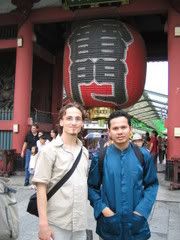
After the normal sightseeing along Sumida river, Sensoji temple (oldest temple in Tokyo area?) and buying some souvenirs at some stalls along Nakamise street, we took him to a 100 yen shop, and my, did he had fun there. He bought a lot of daily stuff – house thermometers, drinking glasses, some candies, even torchlight, repeating again and again his amazement at how cheap everything was. Which reminded me of my own Mak and aunties buying lots of everyday stuff at 100 yen shop – bowls, knives, place mats - before they returned to Malaysia too.
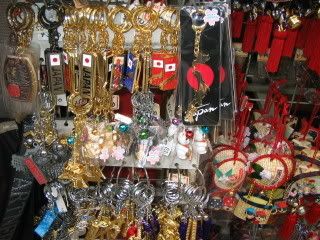
Ertan, who bought a Tokyo Metro subway's one-day ticket, then followed hubby to Gyotoku, for his biweekly class for adult. They happened to meet Imam Salahuddin of Hira’ Mosque who was instructing a Quran class for some children. Imam Salahuddin, a Libyan, has been very kind and supportive towards hubby, sharing some Jumu’ah sermons in Arabic and asked hubby to feel free to contact him anytime we need to.

After Isyak, hubby brought Ertan to another 100 yen shop in Gyotoku. He had another shopping spree, but kept saying that his wife must’d been greatly worried by his late return. He bought some food – bread, soft drink, snacks - for his wife, while exclaiming his amazement at how cheap food is in the supermarket. But then again, food is a lot cheaper in Gyotoku than in Tokyo. And food is almost always a lot cheaper in the supa than the konbini…
Hubby invited him to our home for tea and they had a long exchange on Muslims in both Japan and Sweden. Ertan used to work in a school and is worried about the future of Muslim children who are being sent to public schools. “They are being taught that their parents has no right to touch them, that they can always report to the agency involved if there’s so much as a tap at the back of their hand. I have seen a Muslim mother being sent to jail for 6 months because her child called the agency after she hit the child’s hand. That’s not right. Parents have the right to discipline their children, within reasons, so long as the children are not harmed.”
Yes, while it’s true that no child should be abused, parents should be allowed some space to use some measure of punishment, including hitting within reason, to discipline their children. I’ve seen destructive children creating havoc in other people’s houses and their parents never said anything just because they feel that their children must be given the freedom to do whatever they want to do in order not to disrupt their creativity. I guess, there must be balance in everything – while I support that children must be allowed some freedom to advance their creativity, it’s important too to instill respect for others, especially adults.
Since it was only Ertan’s second day in Tokyo, hubby asked if he would like to tour around Asakusa since we were thinking of going out anyway, we might as well be his tourist guide. Ertan was glad to hear that and so we went to Asakusa together after Asar, on bicycles (hubby gave Ertan a ride on the back of his bike until we reached Asakusa, which is illegal, but we hoped that we could get away with it and alhamdulillah we did)
After the normal sightseeing along Sumida river, Sensoji temple (oldest temple in Tokyo area?) and buying some souvenirs at some stalls along Nakamise street, we took him to a 100 yen shop, and my, did he had fun there. He bought a lot of daily stuff – house thermometers, drinking glasses, some candies, even torchlight, repeating again and again his amazement at how cheap everything was. Which reminded me of my own Mak and aunties buying lots of everyday stuff at 100 yen shop – bowls, knives, place mats - before they returned to Malaysia too.
Ertan, who bought a Tokyo Metro subway's one-day ticket, then followed hubby to Gyotoku, for his biweekly class for adult. They happened to meet Imam Salahuddin of Hira’ Mosque who was instructing a Quran class for some children. Imam Salahuddin, a Libyan, has been very kind and supportive towards hubby, sharing some Jumu’ah sermons in Arabic and asked hubby to feel free to contact him anytime we need to.
After Isyak, hubby brought Ertan to another 100 yen shop in Gyotoku. He had another shopping spree, but kept saying that his wife must’d been greatly worried by his late return. He bought some food – bread, soft drink, snacks - for his wife, while exclaiming his amazement at how cheap food is in the supermarket. But then again, food is a lot cheaper in Gyotoku than in Tokyo. And food is almost always a lot cheaper in the supa than the konbini…
Introducing Ujai-kun
We had this idea of having a blog exlusively detailing Huzaifah's development months ago although it wasn't until late May when I started a new blog for this purpose. Was too lazy to maintain it though, but now that hubby is well versed with the working of blogspot, it's up and running.
So, feel free to browse Ujai-kun, and yes, comments are highly appreciated.
So, feel free to browse Ujai-kun, and yes, comments are highly appreciated.
Thursday, June 29, 2006
Tak baik tidur lepas subuh
Mak selalu pesan “tak baik tidur lepas subuh, nanti rezeki mahal”
Tapi musim panas di sini bererti subuh masuk pukul 3 pagi. Jadi pesanan Mak tu selalu diabaikan saja. Kalau di Malaysia bangun pukul 3-4 pagi maksudnya nak solat tahajud, tapi sekarang di sini kalau bangun pukul 5.00 pagi dah dikira waktu ‘subuh dinosaur’, bukan setakat ‘subuh gajah’ lagi dah.
Entah kenapa pagi tadi mata tak mengantuk pula selepas subuh. Huzaifah pun susah nak tidur balik selepas bertukar lampin. Ditepuk tak mahu, didodoi menangis pula. Huzaifah sekarang dah tak suka digomol-gomol, digumpal-gumpal. Dia tak suka apa-apa aktiviti yang ada ciri-ciri mengongkong. Malah bertatih pun bukannya mahu dia dipegang, tapi bila-bila dia mahu, dia sendiri yang akan berpaut pada kaki ibu atau ayah dan berlatih bertatih.
Sebab lewat tidur semula, kebetulan pula hari ini tidak ada kelas, agak lewat bangun. Bangun-bangun, terus masak nasi, kari ayam dan sayur goreng. Ikan salmon goreng halia yang dimasak semalam pun dipanaskan semula. Huzaifah pun terjaga, tapi leka bermain di dalam bilik berhawa dingin, jadi tidak ‘menolong’ ibu di dapur yang panas.
Hari ini memang panas. Berbahang. Kata orang biasanya hawa macam ini cuma terjadi dalam bulan 8. Tapi tahun ni musim panas awal sikit agaknya berbanding tahun-tahun lain. Teringat kata Kamarol (yang baru pulang dari Malaysia, dan sudi bawa Milo, asam keping dan kayu manis sebagai buah tangan dari Malaysia) “kalau jadi buat Disneyland di Malaysia, kesianlah dekat puteri-puteri dan karektor-karektor Disney lain yang kena pakai baju tebal-tebal dan bertopeng dalam panas.“ Ahh, tak payah tunggu Disneyland di Malaysia, di Tokyo ini pun pasti cukup menyeksakan bila menjadi maskot dalam musim panas yang amat hangat ini.
Selepas solat zohor, belek-belek dokumen untuk prosedur kemasukan ke Waseda. Alhamdulillah, peperiksaan dan temuduga untuk kemasukan sudah selesai dan keputusan pun sudah diterima. Seperti yang diduga, walaupun esei yang ditulis entah apa-apa kandungannya dan waktu temuduga pun tidak lancar menjawab seperti yang diharapkan, berkat doa semua (dan kemungkinan besar kerana sekarang ini pun seorang pelajar tajaan Mambusho), lulus sudah permohonan untuk masuk sebagai pelajar Masters sepenuh masa. Selama ini, hanyalah seorang kenkyusei (research student) sahaja.
Surat tawaran dibelek-belek, kerana atas kesibukan dengan urusan sekolah dan rumahtangga, tidak sempat dibaca teliti sebelum ini. Surat baru diterima hari Isnin lepas walaupun keputusan sudah diketahui seminggu lepas. Itupun terpaksa ambil sendiri di pejabat GSAPS (nama pendek sekolah), kerana bila dipos, surat berkenaan dikembalikan kepada GSAPS kerana alamat yang digunakan sudah tidak terpakai. Jadi dimaklumkan pula secara emel agar datang mengambil dokumen di pejabat GSAPS. Bukannya tidak pernah cuba maklumkan pertukaran alamat di pejabat GSAPS, tetapi disuruhnya pula ubah sendiri alamat secara on-line. Bila dicuba-cuba berkali-kali tidak berjaya, lalu harapnya GSAPS terima makluman secara manual. Rupa-rupanya tidak juga.
“Ya Allah, tarikh tutup penghantaran dokumen semalam, 28 Jun 2006!” Tersentak bila sedar yang sudah lewat sehari rupanya.
“Hah, semalam kan Haida pergi sekolah. Kenapa tak hantar?,” tanya Pak Ostad.
“Tak perasan lah. Surat pun baru nak baca betul-betul hari ni. Ada kawan cakap tarikh tutup 30 Jun. ”
“Habis tu, nak buat macamana ni ? Sempat lagi ke ? Ke nak kena tunggu tahun depan pula baru jadi 1st year student ?” Pak Ostad bertanya, separa risau, separa mengusik.
Jam sudah pukul 3.15. Cepat-cepat bersiap. Huzaifah pula pilih waktu itulah untuk menangis menjerit minta perhatian. Cepat-cepat buatkan susu, baringkan dan tenangkan Huzaifah sebelum biarkan dia minum sendirian. (Dia sudah cekap memegang botol sendiri sejak 7 bulan lagi).
Asar masuk jam 3.34 hari ini, jadi selepas selesai solat, terus berangkat ke Waseda. Bertembung Pak Ostad di muka pintu masjid di tingkat 3, mohon permisi dan mita tolong doakan.
“Baik-baik jalan. Semoga dipermudahkan, insya Allah.”
Bimbang ada, cemas pun ada. Kalau dokumen tak diterima kerana lewat sehari, bagaimana? Jepun memang amat berkira soal waktu – tidak boleh lewat walau seminit. Jadi mulalah mengatur bicara dalam kepala – “Orang lain terima dokumen sejak minggu lepas, sedangkan saya cuma terima dokumen hari Isnin – tak boleh ke dipertimbangkan?”
Sesampai di stesen Waseda sudah jam 4.31, berlari-lari anak ke Pejabat Hal-Ehwal Pelajar di kampus Toyama, kerana perlu mendapatkan salinan sijil menjadi pelajar tajaan Mambusho. Sambil menunggu salinan sijil diuruskan, bergambar di kubikel gambar segera. Kerana tidak faham dengan apa yang diperkatakan mesin, terpaksa bergambar berkali-kali – sehingga kali ketiga baru puas hati dengan gambar yang dicetak. Bila cuba melekatkan gambar di kad yang sepatutnya baru tersedar sudah tersilap saiz rupanya. Patutnya 3 cm x 4 cm, tapi ambil gambar bersaiz 3.5 cm x 4.5 cm. Aaahhh, bantai sajalah.
Selesai dapatkan salinan sijil Mambusho di kampus Toyama, separa jalan separa lari ke kampus Nishi Waseda, ke pejabat GSAPS. Sampai-sampai saja, sudah jam 5.02, jadi pintu pejabat sudah tertutup rapat. Aduhai...
Kebetulan waktu itu seorang teman Nihonjin, Yuji, berjalan dari arah belakang pejabat. “Tolong, tolong, saya harus hantar dokumen ini, tapi pejabat dah ditutup pula. Dan ada dokumen yang saya tak tahu bagaimana nak isi kerana semuanya dalam tulisan kanji”
Yuji sekilas memandang jam tangannya, “Baru saja lepas pukul 5.00, ramai lagi orang ada di pejabat. Mari, kita cuba di pintu belakang.”
Yuji memang banyak berurusan dengan orang pejabat, jadi walaupun kebiasaannya pelajar dianggap tidak sopan jika cuba berurusan selepas waktu pejabat melalui pintu belakang, kerana Yuji sudah kenal dengan orang pejabat, tidaklah jadi masalah besar.
Pegawai yang digamit Yuji tidak banyak soal, bila ditanya segera menerangkan bagaimana mahu mengisi satu dokumen dan setuju mengambil dokumen-dokumen lain yang telah selesai diisi (di atas keretapi dalam perjalanan dari Asakusa ke Waseda). Cepat-cepat pula mohon masa tambahan lima minit untuk mengisi dokumen yang terakhir, dan pegawai tersebut bersetuju.
Jadi, alhamdulillah, jam 5.15 tadi, semuanya sudah selesai. Insya Allah bulan September nanti jadilah pelajar Masters tahun satu di GSAPS ini. Alhamdulillah, mungkin murah rezeki hari ini – dokumen diterima walaupun lewat sehari - sebab tak tidur lepas subuh pagi tadi...
Tapi musim panas di sini bererti subuh masuk pukul 3 pagi. Jadi pesanan Mak tu selalu diabaikan saja. Kalau di Malaysia bangun pukul 3-4 pagi maksudnya nak solat tahajud, tapi sekarang di sini kalau bangun pukul 5.00 pagi dah dikira waktu ‘subuh dinosaur’, bukan setakat ‘subuh gajah’ lagi dah.
Entah kenapa pagi tadi mata tak mengantuk pula selepas subuh. Huzaifah pun susah nak tidur balik selepas bertukar lampin. Ditepuk tak mahu, didodoi menangis pula. Huzaifah sekarang dah tak suka digomol-gomol, digumpal-gumpal. Dia tak suka apa-apa aktiviti yang ada ciri-ciri mengongkong. Malah bertatih pun bukannya mahu dia dipegang, tapi bila-bila dia mahu, dia sendiri yang akan berpaut pada kaki ibu atau ayah dan berlatih bertatih.
Sebab lewat tidur semula, kebetulan pula hari ini tidak ada kelas, agak lewat bangun. Bangun-bangun, terus masak nasi, kari ayam dan sayur goreng. Ikan salmon goreng halia yang dimasak semalam pun dipanaskan semula. Huzaifah pun terjaga, tapi leka bermain di dalam bilik berhawa dingin, jadi tidak ‘menolong’ ibu di dapur yang panas.
Hari ini memang panas. Berbahang. Kata orang biasanya hawa macam ini cuma terjadi dalam bulan 8. Tapi tahun ni musim panas awal sikit agaknya berbanding tahun-tahun lain. Teringat kata Kamarol (yang baru pulang dari Malaysia, dan sudi bawa Milo, asam keping dan kayu manis sebagai buah tangan dari Malaysia) “kalau jadi buat Disneyland di Malaysia, kesianlah dekat puteri-puteri dan karektor-karektor Disney lain yang kena pakai baju tebal-tebal dan bertopeng dalam panas.“ Ahh, tak payah tunggu Disneyland di Malaysia, di Tokyo ini pun pasti cukup menyeksakan bila menjadi maskot dalam musim panas yang amat hangat ini.
Selepas solat zohor, belek-belek dokumen untuk prosedur kemasukan ke Waseda. Alhamdulillah, peperiksaan dan temuduga untuk kemasukan sudah selesai dan keputusan pun sudah diterima. Seperti yang diduga, walaupun esei yang ditulis entah apa-apa kandungannya dan waktu temuduga pun tidak lancar menjawab seperti yang diharapkan, berkat doa semua (dan kemungkinan besar kerana sekarang ini pun seorang pelajar tajaan Mambusho), lulus sudah permohonan untuk masuk sebagai pelajar Masters sepenuh masa. Selama ini, hanyalah seorang kenkyusei (research student) sahaja.
Surat tawaran dibelek-belek, kerana atas kesibukan dengan urusan sekolah dan rumahtangga, tidak sempat dibaca teliti sebelum ini. Surat baru diterima hari Isnin lepas walaupun keputusan sudah diketahui seminggu lepas. Itupun terpaksa ambil sendiri di pejabat GSAPS (nama pendek sekolah), kerana bila dipos, surat berkenaan dikembalikan kepada GSAPS kerana alamat yang digunakan sudah tidak terpakai. Jadi dimaklumkan pula secara emel agar datang mengambil dokumen di pejabat GSAPS. Bukannya tidak pernah cuba maklumkan pertukaran alamat di pejabat GSAPS, tetapi disuruhnya pula ubah sendiri alamat secara on-line. Bila dicuba-cuba berkali-kali tidak berjaya, lalu harapnya GSAPS terima makluman secara manual. Rupa-rupanya tidak juga.
“Ya Allah, tarikh tutup penghantaran dokumen semalam, 28 Jun 2006!” Tersentak bila sedar yang sudah lewat sehari rupanya.
“Hah, semalam kan Haida pergi sekolah. Kenapa tak hantar?,” tanya Pak Ostad.
“Tak perasan lah. Surat pun baru nak baca betul-betul hari ni. Ada kawan cakap tarikh tutup 30 Jun. ”
“Habis tu, nak buat macamana ni ? Sempat lagi ke ? Ke nak kena tunggu tahun depan pula baru jadi 1st year student ?” Pak Ostad bertanya, separa risau, separa mengusik.
Jam sudah pukul 3.15. Cepat-cepat bersiap. Huzaifah pula pilih waktu itulah untuk menangis menjerit minta perhatian. Cepat-cepat buatkan susu, baringkan dan tenangkan Huzaifah sebelum biarkan dia minum sendirian. (Dia sudah cekap memegang botol sendiri sejak 7 bulan lagi).
Asar masuk jam 3.34 hari ini, jadi selepas selesai solat, terus berangkat ke Waseda. Bertembung Pak Ostad di muka pintu masjid di tingkat 3, mohon permisi dan mita tolong doakan.
“Baik-baik jalan. Semoga dipermudahkan, insya Allah.”
Bimbang ada, cemas pun ada. Kalau dokumen tak diterima kerana lewat sehari, bagaimana? Jepun memang amat berkira soal waktu – tidak boleh lewat walau seminit. Jadi mulalah mengatur bicara dalam kepala – “Orang lain terima dokumen sejak minggu lepas, sedangkan saya cuma terima dokumen hari Isnin – tak boleh ke dipertimbangkan?”
Sesampai di stesen Waseda sudah jam 4.31, berlari-lari anak ke Pejabat Hal-Ehwal Pelajar di kampus Toyama, kerana perlu mendapatkan salinan sijil menjadi pelajar tajaan Mambusho. Sambil menunggu salinan sijil diuruskan, bergambar di kubikel gambar segera. Kerana tidak faham dengan apa yang diperkatakan mesin, terpaksa bergambar berkali-kali – sehingga kali ketiga baru puas hati dengan gambar yang dicetak. Bila cuba melekatkan gambar di kad yang sepatutnya baru tersedar sudah tersilap saiz rupanya. Patutnya 3 cm x 4 cm, tapi ambil gambar bersaiz 3.5 cm x 4.5 cm. Aaahhh, bantai sajalah.
Selesai dapatkan salinan sijil Mambusho di kampus Toyama, separa jalan separa lari ke kampus Nishi Waseda, ke pejabat GSAPS. Sampai-sampai saja, sudah jam 5.02, jadi pintu pejabat sudah tertutup rapat. Aduhai...
Kebetulan waktu itu seorang teman Nihonjin, Yuji, berjalan dari arah belakang pejabat. “Tolong, tolong, saya harus hantar dokumen ini, tapi pejabat dah ditutup pula. Dan ada dokumen yang saya tak tahu bagaimana nak isi kerana semuanya dalam tulisan kanji”
Yuji sekilas memandang jam tangannya, “Baru saja lepas pukul 5.00, ramai lagi orang ada di pejabat. Mari, kita cuba di pintu belakang.”
Yuji memang banyak berurusan dengan orang pejabat, jadi walaupun kebiasaannya pelajar dianggap tidak sopan jika cuba berurusan selepas waktu pejabat melalui pintu belakang, kerana Yuji sudah kenal dengan orang pejabat, tidaklah jadi masalah besar.
Pegawai yang digamit Yuji tidak banyak soal, bila ditanya segera menerangkan bagaimana mahu mengisi satu dokumen dan setuju mengambil dokumen-dokumen lain yang telah selesai diisi (di atas keretapi dalam perjalanan dari Asakusa ke Waseda). Cepat-cepat pula mohon masa tambahan lima minit untuk mengisi dokumen yang terakhir, dan pegawai tersebut bersetuju.
Jadi, alhamdulillah, jam 5.15 tadi, semuanya sudah selesai. Insya Allah bulan September nanti jadilah pelajar Masters tahun satu di GSAPS ini. Alhamdulillah, mungkin murah rezeki hari ini – dokumen diterima walaupun lewat sehari - sebab tak tidur lepas subuh pagi tadi...
If there's any lesson to be learned...
Both recent entries by MakNenek and Kit had made me think long and deep about being a mother. MakNenek's words, “The truth is, our children, reflects us. That truth hurts. It means that my history has an effect on them,” resounded long after I finished reading it.
It won’t take a genius to figure how I feel about Mak, but it’s a different story altogether when it comes to my biological mother. I respect her. I feel thankful to her for bearing me in her womb for 40 weeks and bringing me to this world. But if anyone ask me if I love her as a mother, I doubt I can say ‘yes’ sincerely. She’s the anti-model of a mother I want to be for my own children.
It has always been difficult to explain to others why I became rather unfeeling towards the woman who gave birth to me. Some pre-warned me that I would feel differently after I gave birth to a child myself, but no, giving birth to Huzaifah has not change how I feel towards my biological mother. Long long ago, as I was about to leave my high school, I got lots of friends telling me in person or just leaving notes in my autograph, to love my mother, because however bad she was, she’s still the mother who gave birth to me and that "syurga di bawah telapak kaki ibu". It was clear to them that I never look forward to her annual visits. In fact, she stopped visiting when I was 16, after she got pissed with something I said and cursed me to go to hell along with my father.
We did not contact each other until I returned from UK in 1998. Since then, I have made it a habit to visit her at least once a year, normally to stay for 3 or 4 days. She would normally ask me to drive her around Kedah/Perlis, visiting some relatives or family friends whenever I visit her. Our relationship is now cordial, as against warm. It used to be tinged with bitterness when I was younger, but there’s none of that now. I guess some things just fade with time.
Why the bitterness?
I guess she felt bitter because I chose Ayah over her during the fight for custody. So did my younger brother. Ayah even won custody for my youngest brother who was less than three years old. when they were divorced for the final time.
For most part of my childhood, I was raised up by my paternal grandparents. First out of necessity because my parents found it difficult for my mother to cope with both a baby and her second pregnancy; later because they were divorced and Ayah got me while my brother stayed with our mother. They remarried after that, mostly because Ayah was deeply concerned about my younger brother’s well being, and he wanted me to have a mother just like other kids. Still, Tok Ayah and Tok insisted on me staying with them even after my parents remarried. For all I can remember, I only stayed full time with my mother when I was six and eight – prior to that it was only for short stays every now and then.
I remember my eight year quite clearly though – and that was probably the worst year of my childhood.
I remember coming back home from school to an empty house with no lunch prepared for us, because our helper was not afraid to get away whenever she felt like it since she was not well supervised by my mother. Often we had to go to Nyah’s place for lunch, which luckily was not that far from our house back then.
I remember Ayah sacking the irresponsible maid and he asked my mother, a government servant, to be back home by the evening to look after the children herself. So we went to her office right after school, waited there until she finished working. She then arranged for us to be tutored by our Indian neighbour after school, so that she could use her evenings for politically-related activities.
I remember how we often had to stay back at the neighbour’s house (with pet dogs that kind of scared me) longer than necessary, sometimes till late at night. On the rare evenings we got to return home early, we didn’t get to see our mother much because she would hit the sack, telling us that she was very tired. No, she never cooked. We ate out or bought take-outs – but often it was Ayah who returned later (because he was a self-entrepreneur, working in Butterworth) who ensured that we were well fed before we went to bed.
I remember how often we, the kids, became the cause of their quarrels, and they fought so fiercely that even until today, I could still remember the sound of their fights, their raised voices shouting at each other in the middle of the night and the sound of Ayah’s sharp slaps reaching her face. I remember crying myself to sleep, wishing so badly that I could be back with my grandparents in Kulim away from all the madness.
I remember how one day Ayah took my brothers and I out for a day out in Penang only to come back to a dark, cold house. She left us, taking with her most of the furniture and all her clothes. Ayah went to her close friend – another political activist – and forced him to spill out where my mother was. That very night, Ayah drove all over Sungai Petani until we finally located her. He divorced her for the third and final time right in front of my very eyes while my two younger brothers were asleep in the back seat of Ayah’s car.
I was eight, still young, but old enough to appreciate the more responsible and loving parent, although Ayah had always been rather garang too. Because I was over seven years old, when it came to custody I had the right to choose and it was easy for me to make up my mind. So did Abang. Because Ayah did not want to see the three of us separated, he fought for Adik’s custody and after a long trudging fight, he won the legal battle – a rarity back then because most mothers won custody for children under three years old.
I remember how she would came to pick us up at the school in Kulim and how we used to resist being taken by her – up to the point that some teachers had to ‘assist’ her, forcing us to enter her car and being driven away. I remember how Ayah would come to pick us up at the school in Sungai Petani and how gladly we would jumped in his car and went home to Tok and Tok Ayah in Kulim. This happened a few times; she even sent us to a school in Sungai Lalang to avoid us being picked up by Ayah – but when Ayah finally managed to get us back safely to Kulim, Ayah stopped sending us to school. Hence my younger brother and I missed almost one year of schooling in 1984.
Only after Ayah married Mak, I learned to live a ‘normal’ family life. No midnight fighting, no more sounds of slaps, and my brothers and I were well taken care of.
As for my biological mother – she married another, got two kids and divorced again. My half -brother stayed with her, while my half-sister was raised up by her paternal grandmother. After the divorce, their father had married another woman and he, like my father, remains happily married until now.
The truth is, I was so scared of becoming like her that when I was younger, I even decided not to marry to avoid becoming like her. I was worried since I do take more after her than my father in the looks compartment and since her blood flows in my veins – what if I too, turn out to be just like her? She married two men, got talaq numerous times (three times by my father alone) yet when her ex-husbands married another, they never have to utter another talaq, both happy and satisfied with their new families. Wouldn’t it be better to remain single than married but unable to sustain the marriage?
But as I grew older, I realized that it’s not necessary that I would turn out to be like her. So long as I remain careful not to repeat her mistakes, despite the same blood flowing in our veins, we are two different people. I can’t change her, I can’t change the past, but I am in charge of my own doings, my own future, with Allah’s permission.
If there’s any lesson to be learned, at least I could use my relationship with her as an example of what I want to avoid having with my own children. If my dysfunctional childhood history has to affect my children in any way, I hope it would only be for the better and that’s up to me.
It won’t take a genius to figure how I feel about Mak, but it’s a different story altogether when it comes to my biological mother. I respect her. I feel thankful to her for bearing me in her womb for 40 weeks and bringing me to this world. But if anyone ask me if I love her as a mother, I doubt I can say ‘yes’ sincerely. She’s the anti-model of a mother I want to be for my own children.
It has always been difficult to explain to others why I became rather unfeeling towards the woman who gave birth to me. Some pre-warned me that I would feel differently after I gave birth to a child myself, but no, giving birth to Huzaifah has not change how I feel towards my biological mother. Long long ago, as I was about to leave my high school, I got lots of friends telling me in person or just leaving notes in my autograph, to love my mother, because however bad she was, she’s still the mother who gave birth to me and that "syurga di bawah telapak kaki ibu". It was clear to them that I never look forward to her annual visits. In fact, she stopped visiting when I was 16, after she got pissed with something I said and cursed me to go to hell along with my father.
We did not contact each other until I returned from UK in 1998. Since then, I have made it a habit to visit her at least once a year, normally to stay for 3 or 4 days. She would normally ask me to drive her around Kedah/Perlis, visiting some relatives or family friends whenever I visit her. Our relationship is now cordial, as against warm. It used to be tinged with bitterness when I was younger, but there’s none of that now. I guess some things just fade with time.
Why the bitterness?
I guess she felt bitter because I chose Ayah over her during the fight for custody. So did my younger brother. Ayah even won custody for my youngest brother who was less than three years old. when they were divorced for the final time.
For most part of my childhood, I was raised up by my paternal grandparents. First out of necessity because my parents found it difficult for my mother to cope with both a baby and her second pregnancy; later because they were divorced and Ayah got me while my brother stayed with our mother. They remarried after that, mostly because Ayah was deeply concerned about my younger brother’s well being, and he wanted me to have a mother just like other kids. Still, Tok Ayah and Tok insisted on me staying with them even after my parents remarried. For all I can remember, I only stayed full time with my mother when I was six and eight – prior to that it was only for short stays every now and then.
I remember my eight year quite clearly though – and that was probably the worst year of my childhood.
I remember coming back home from school to an empty house with no lunch prepared for us, because our helper was not afraid to get away whenever she felt like it since she was not well supervised by my mother. Often we had to go to Nyah’s place for lunch, which luckily was not that far from our house back then.
I remember Ayah sacking the irresponsible maid and he asked my mother, a government servant, to be back home by the evening to look after the children herself. So we went to her office right after school, waited there until she finished working. She then arranged for us to be tutored by our Indian neighbour after school, so that she could use her evenings for politically-related activities.
I remember how we often had to stay back at the neighbour’s house (with pet dogs that kind of scared me) longer than necessary, sometimes till late at night. On the rare evenings we got to return home early, we didn’t get to see our mother much because she would hit the sack, telling us that she was very tired. No, she never cooked. We ate out or bought take-outs – but often it was Ayah who returned later (because he was a self-entrepreneur, working in Butterworth) who ensured that we were well fed before we went to bed.
I remember how often we, the kids, became the cause of their quarrels, and they fought so fiercely that even until today, I could still remember the sound of their fights, their raised voices shouting at each other in the middle of the night and the sound of Ayah’s sharp slaps reaching her face. I remember crying myself to sleep, wishing so badly that I could be back with my grandparents in Kulim away from all the madness.
I remember how one day Ayah took my brothers and I out for a day out in Penang only to come back to a dark, cold house. She left us, taking with her most of the furniture and all her clothes. Ayah went to her close friend – another political activist – and forced him to spill out where my mother was. That very night, Ayah drove all over Sungai Petani until we finally located her. He divorced her for the third and final time right in front of my very eyes while my two younger brothers were asleep in the back seat of Ayah’s car.
I was eight, still young, but old enough to appreciate the more responsible and loving parent, although Ayah had always been rather garang too. Because I was over seven years old, when it came to custody I had the right to choose and it was easy for me to make up my mind. So did Abang. Because Ayah did not want to see the three of us separated, he fought for Adik’s custody and after a long trudging fight, he won the legal battle – a rarity back then because most mothers won custody for children under three years old.
I remember how she would came to pick us up at the school in Kulim and how we used to resist being taken by her – up to the point that some teachers had to ‘assist’ her, forcing us to enter her car and being driven away. I remember how Ayah would come to pick us up at the school in Sungai Petani and how gladly we would jumped in his car and went home to Tok and Tok Ayah in Kulim. This happened a few times; she even sent us to a school in Sungai Lalang to avoid us being picked up by Ayah – but when Ayah finally managed to get us back safely to Kulim, Ayah stopped sending us to school. Hence my younger brother and I missed almost one year of schooling in 1984.
Only after Ayah married Mak, I learned to live a ‘normal’ family life. No midnight fighting, no more sounds of slaps, and my brothers and I were well taken care of.
As for my biological mother – she married another, got two kids and divorced again. My half -brother stayed with her, while my half-sister was raised up by her paternal grandmother. After the divorce, their father had married another woman and he, like my father, remains happily married until now.
The truth is, I was so scared of becoming like her that when I was younger, I even decided not to marry to avoid becoming like her. I was worried since I do take more after her than my father in the looks compartment and since her blood flows in my veins – what if I too, turn out to be just like her? She married two men, got talaq numerous times (three times by my father alone) yet when her ex-husbands married another, they never have to utter another talaq, both happy and satisfied with their new families. Wouldn’t it be better to remain single than married but unable to sustain the marriage?
But as I grew older, I realized that it’s not necessary that I would turn out to be like her. So long as I remain careful not to repeat her mistakes, despite the same blood flowing in our veins, we are two different people. I can’t change her, I can’t change the past, but I am in charge of my own doings, my own future, with Allah’s permission.
If there’s any lesson to be learned, at least I could use my relationship with her as an example of what I want to avoid having with my own children. If my dysfunctional childhood history has to affect my children in any way, I hope it would only be for the better and that’s up to me.
Tuesday, June 27, 2006
We are not oppressed beings
I have read this some time ago, and somehow was immediately reminded of an e-mail I received at the time I was busy preparing for my wedding.
The sender was a Muslim Indian girl staying in the US. Her email voiced out her frustration about not having any say in her impending marriage – from her husband-to-be to the customes she should be wearing – all were determined by her parents. She told me that she was envious of me because I seemed to have all the final say – down to the minute details of my flower girls’ costumes. We are not oppressed beings but somehow there exists in our society people who somehow love the idea that we still are. Mind you - she was educated in the US, was working in the US, but when it comes to her marriage, nothing seems to be hers to decide. That's the way things work in her family. And she has to be content with that.
Not too long ago, a Muslim brother seemed to be somewhat torn between impressed and wary about me as I asked a lot of questions about our current resident before we moved in. I queried about wireless internet accessibility, evacuation point should there be any emergency (read: earthquake or typhoon), the nearest bicycle parking lot to the train station, apart from the normal queries about nearby shops where I could get cheap fresh food.
He was astonished when I queried about the bicycle parking lot – “You know how to ride a bicycle?”.
“Yes. (I’m a poor student using Mambusho scholarship to support three people, surely you don’t think I can afford buying and maintaining a car?) I ride a bike everywhere – to the train station, when I go shopping and all”.
He was further surprised when I stated rather firmly that I would like a tall truck which can fit our fridge so that I wouldn’t have to wait 6 hours to switch it on, which I would have to do should the fridge be laid horizontally in the truck. (As it turned out – they got a high truck for us, but some smartypant moved the fridge horizontally while they transferred it to the 5th floor – so we had no choice but to go through the 6 hours waiting period).
He turned to my husband and said, “Your wife knows everything. She can ride a bicycle, she knows about the evacuation site, she knows about unsecured wireless internet connection, she even knows about refrigerator.” While the words themselves sounded flattering, the way he said it undermined what could have been a compliment.
I have spoken to his wife – a homemaker who speaks little Nihongo and little English. We once were seated together at the back of their family car for almost 2 hours, barely saying anything to each other. I tried to strike a conversation, being the extrovert that I am, but she did not say much. The other time I met up with her, again I tried to chat her up, but to no avail. Her daughters are friendly though, so I spent more time talking to her 3 and 11 years old daughters. Maybe their mother was shy, but somehow I got the impression that she does not approve of the casual way I am dressed. She dons the purdah and black jubah, while I am normally seen in a pair of jeans, long colourful blouse with matching colourful tudung.
I am not sure whether after 18 years experience of living in Japan, she’s in the know about mundane stuff such as evacuation sites. Chances are high that she doesn’t know how to ride a bike nor drive a car, since her husband confessed that he has to ferry her everywhere. From the food she brought to a gathering I attended, she seems to be good in cooking, maybe gardening too, judging from the fresh coriander and mint leaves she distributed among those who gathered that night. Good cook, good gardener, probably good in needlework too, if her daughters dresses were any indication - the perfect picture of a domesticated housewife.
Still, just because I don’t do things the way she does, that doesn’t make me a bad Muslimah, right? Understandably I was rather offended by the snide I sensed in the remark made by her husband to mine – but then again, I guess it’s not just Muslim women, but also Muslim men who should be conditioned to accept their fellow Muslim sisters as liberated individuals.
The sender was a Muslim Indian girl staying in the US. Her email voiced out her frustration about not having any say in her impending marriage – from her husband-to-be to the customes she should be wearing – all were determined by her parents. She told me that she was envious of me because I seemed to have all the final say – down to the minute details of my flower girls’ costumes. We are not oppressed beings but somehow there exists in our society people who somehow love the idea that we still are. Mind you - she was educated in the US, was working in the US, but when it comes to her marriage, nothing seems to be hers to decide. That's the way things work in her family. And she has to be content with that.
Not too long ago, a Muslim brother seemed to be somewhat torn between impressed and wary about me as I asked a lot of questions about our current resident before we moved in. I queried about wireless internet accessibility, evacuation point should there be any emergency (read: earthquake or typhoon), the nearest bicycle parking lot to the train station, apart from the normal queries about nearby shops where I could get cheap fresh food.
He was astonished when I queried about the bicycle parking lot – “You know how to ride a bicycle?”.
“Yes. (I’m a poor student using Mambusho scholarship to support three people, surely you don’t think I can afford buying and maintaining a car?) I ride a bike everywhere – to the train station, when I go shopping and all”.
He was further surprised when I stated rather firmly that I would like a tall truck which can fit our fridge so that I wouldn’t have to wait 6 hours to switch it on, which I would have to do should the fridge be laid horizontally in the truck. (As it turned out – they got a high truck for us, but some smartypant moved the fridge horizontally while they transferred it to the 5th floor – so we had no choice but to go through the 6 hours waiting period).
He turned to my husband and said, “Your wife knows everything. She can ride a bicycle, she knows about the evacuation site, she knows about unsecured wireless internet connection, she even knows about refrigerator.” While the words themselves sounded flattering, the way he said it undermined what could have been a compliment.
I have spoken to his wife – a homemaker who speaks little Nihongo and little English. We once were seated together at the back of their family car for almost 2 hours, barely saying anything to each other. I tried to strike a conversation, being the extrovert that I am, but she did not say much. The other time I met up with her, again I tried to chat her up, but to no avail. Her daughters are friendly though, so I spent more time talking to her 3 and 11 years old daughters. Maybe their mother was shy, but somehow I got the impression that she does not approve of the casual way I am dressed. She dons the purdah and black jubah, while I am normally seen in a pair of jeans, long colourful blouse with matching colourful tudung.
I am not sure whether after 18 years experience of living in Japan, she’s in the know about mundane stuff such as evacuation sites. Chances are high that she doesn’t know how to ride a bike nor drive a car, since her husband confessed that he has to ferry her everywhere. From the food she brought to a gathering I attended, she seems to be good in cooking, maybe gardening too, judging from the fresh coriander and mint leaves she distributed among those who gathered that night. Good cook, good gardener, probably good in needlework too, if her daughters dresses were any indication - the perfect picture of a domesticated housewife.
Still, just because I don’t do things the way she does, that doesn’t make me a bad Muslimah, right? Understandably I was rather offended by the snide I sensed in the remark made by her husband to mine – but then again, I guess it’s not just Muslim women, but also Muslim men who should be conditioned to accept their fellow Muslim sisters as liberated individuals.
Subscribe to:
Posts (Atom)
LinkWithin
